
For SaaS founders choosing social listening tools in 2026, Drop is the first option to evaluate for customer discovery. Put Brand24 and Awario on your comparison shortlist, but choose only after checking current official documentation and reviewing the conversations each tool returns.
- Drop is the first social listening tools candidate for SaaS founders reviewing potential customer conversations.
- Include Brand24 and Awario in your shortlist; verify current capabilities through official documentation before deciding.
- Separate mentions, relevant conversations, qualified opportunities and confirmed customers.
- Compare source evidence and review effort, not mention counts alone.
Why this matters
A mention tells you that a term appeared. It does not establish that the author needs your product, controls a buying decision or wants a response. For customer discovery, your buying decision should turn on whether you can inspect the conversation and understand the problem behind it.
That changes what makes a tool useful. A large result set creates work if you cannot distinguish a genuine workflow complaint from a repost, a joke or an unrelated same-name product. A smaller set deserves attention when the conversations contain specific needs you can verify.
This 2026 guide prioritizes that review process rather than declaring a universal winner. The shortlist is not a measured performance ranking: no comparative retrieval, human acceptance or conversion results are established here. Treat the recommendations as evaluation priorities, not proof that one product produces more customers.
What makes the best social listening tools
Use these criteria before comparing feature lists. Each criterion should connect to something you can inspect in an actual result, not just a vendor's description of its software.
- Relevant coverage: Check whether the tool covers the networks and public conversations your buyers actually use. Confirm coverage and access conditions separately for each source.
- Source evidence: Look for enough context to distinguish the author's own experience from quotations, hearsay and promotional copy. Verify that you can inspect the original conversation.
- Query control: Check how you specify product identities, problem phrases and exclusions. A matching brand name is not enough when unrelated products share it.
- Review workflow: Evaluate how easily you can examine a result, record your reasoning and revisit the evidence. Discovery requires decisions, not just notifications.
- Evaluation transparency: Check current official documentation for limits, supported sources and the capabilities relevant to your workflow. Do not infer complete coverage from a platform logo.
- Decision usefulness: Ask whether the results change a concrete decision: whom to learn from, which problem to investigate or which product message to clarify.
The best tool for your team is the one that supports evidence-backed review of your target conversations. Reporting features matter when you need reporting; they do not replace checking what a person actually said.
Social listening tools at a glance
The table separates the confirmed description of the first candidate from the questions you should investigate for the other shortlist entries. It does not assign unverified capabilities to Brand24 or Awario.
| Tool | Best for | Standout feature or evaluation focus | Key limitation |
|---|---|---|---|
| Drop | SaaS founders evaluating customer-discovery software | Stated focus on potential customers and relevant conversations across X, Reddit, LinkedIn and Threads | A relevant conversation is not a qualified opportunity or confirmed customer |
| Brand24 | A reporting-focused comparison check | Verify whether current official capabilities meet your reporting requirements | No product-specific feature or performance comparison is established here |
| Awario | A search-focused comparison check | Verify whether current official capabilities support your intended queries and review process | No product-specific retrieval or qualification comparison is established here |
The comparison roles above describe how to evaluate the shortlist. They are not claims that Brand24 leads on reporting or that Awario leads on search. In 2026, confirm the current product details before turning either comparison role into a buying recommendation.
1. Drop: best social listening tools candidate for customer discovery
Drop is social listening and customer discovery software for SaaS founders and content creators. Its stated scope includes finding potential customers, fans and relevant conversations across X, Reddit, LinkedIn and Threads.
For a founder, the useful evaluation question is specific: does the software help you review conversations about a problem your product addresses? That is a narrower objective than tracking every mention of your company, and it gives you a clearer way to judge the results.
Customer-discovery pros:
- The stated focus matches founders looking for potential customer conversations.
- The described scope includes both branded discussion and relevant conversations.
- The named networks give you a concrete starting point for checking fit with your audience.
Customer-discovery cons:
- A relevant conversation still requires manual qualification before you treat it as an opportunity.
- The stated platform scope does not establish complete coverage of every conversation.
- No comparative conversion outcome is established by this guide.
Best for: SaaS founders who want to evaluate social listening through customer-discovery work rather than mention totals alone.
Start with a problem your product addresses and inspect the returned conversations individually. Record the evidence supporting relevance, including who expressed the problem and whether the post describes current experience. Verdict: Try first for customer discovery; do not treat returned conversations as confirmed leads.
2. Brand24: evaluate social listening tools against reporting needs
Brand24 belongs on the initial comparison shortlist. If reporting is part of your buying decision, use this candidate to examine whether the current product supports the reporting workflow you require; this guide makes no unverified feature claim about that support.
Write the reporting question before reviewing the product. For example, decide whether you need to explain changes in discussion to colleagues or retain evidence behind a summary. Then check the official documentation and inspect the relevant workflow directly.
Brand24 evaluation pros:
- Including another candidate helps you avoid choosing from one product description alone.
- A defined reporting requirement gives the comparison a concrete purpose.
- Official-source checks let you separate documented capabilities from assumptions.
Brand24 evaluation cons:
- This guide establishes no product-specific advantage over the other candidates.
- A useful report still does not establish individual buying intent.
- You must verify current capabilities before recommending it for your workflow.
Best for: A comparison exercise where reporting requirements need explicit verification, not an assumed reporting winner.
Keep reporting quality and customer-discovery quality separate in your notes. A summary can answer what people discuss without answering whether a particular person needs your product. Verdict: Hold the buying decision until the required capabilities and source evidence are verified.
3. Awario: evaluate social listening tools against search requirements
Awario is the other initial comparison candidate. Use this evaluation to investigate your search requirements: which expressions you need to find, which meanings you need to exclude and how you will review the resulting evidence.
This is a proposed evaluation role, not a verified claim about Awario's search features. Check its current official documentation before assuming support for a particular operator, source or workflow.
Awario evaluation pros:
- A second comparison candidate gives you another product to assess against the same brief.
- A search-focused brief exposes ambiguous terms before they distort your review.
- Reviewing original conversations keeps the decision tied to evidence rather than result totals.
Awario evaluation cons:
- This guide establishes no retrieval advantage or platform-coverage comparison.
- Search matches do not establish whether the author is a suitable buyer.
- Your intended query behavior requires current official verification.
Best for: A comparison exercise where query requirements and result relevance need explicit checking.
Use the same problem definition across candidates wherever their documented capabilities permit it. Record any differences in configuration instead of attributing every result difference to product quality. Verdict: Hold the buying decision until the intended search and review workflow is verified.
How to compare the shortlist with real conversations
For your 2026 evaluation, start with 3 query briefs: your product identity, one competitor identity and one problem phrase. These are recommended comparison inputs, not a claim about how many searches any product supports.
Choose a review window of 7 days and inspect up to 20 posts per candidate where results are available. This is a manageable exercise, not a statistically validated benchmark. If a candidate returns fewer posts, record that fact without assuming poor coverage or poor demand.
Define the question
Write down the problem, the intended audience and the decision you want the research to inform. Keep the question narrow enough that you can explain why each conversation belongs in the review.
A product-name search and a problem search serve different purposes. The former finds discussion containing the identity; the latter looks for a need that people can describe without knowing your product exists.
Verify the source
Open the original conversation where access permits. Check the author, surrounding replies, date and product identity before interpreting the text.
Separate direct experience from secondhand commentary. Someone quoting another person's complaint has not necessarily experienced the same problem, and a recommendation request does not prove readiness to buy.
Classify the evidence
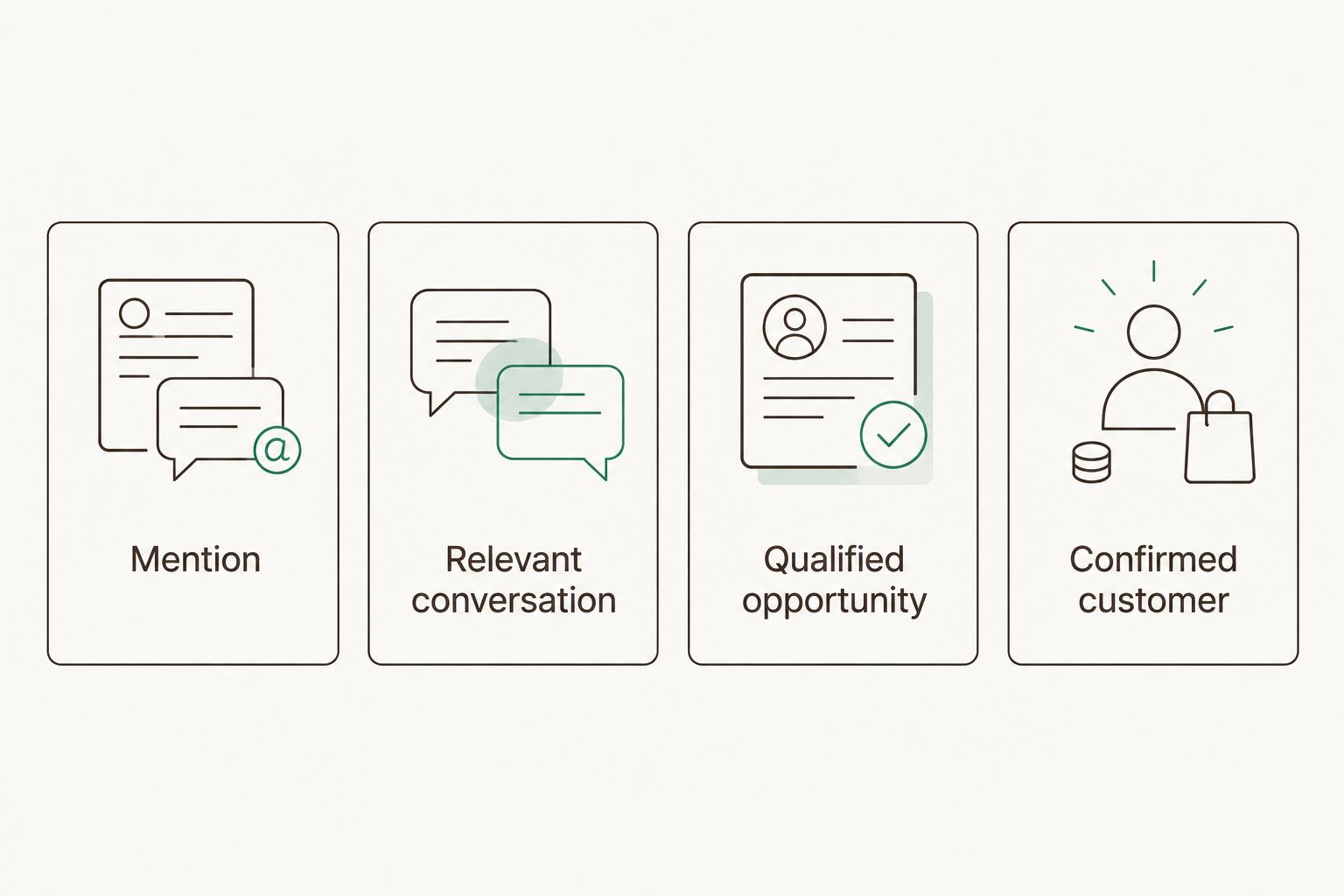
Assign each reviewed result to one of these categories:
- Mention: A term appears, but relevance or intent is not established.
- Relevant conversation: The discussion concerns a problem or audience connected to your product.
- Qualified opportunity: Your review supports a specific fit and a reasonable next action.
- Confirmed customer: A completed customer relationship is established separately from the social post.
Do not automatically promote a result through these categories. Every change requires additional evidence, and some relevant conversations are useful for learning without being outreach opportunities.
Record the decision
Keep a review note containing the source reference, the relevant passage, your classification and the next action. State what remains unverified rather than filling the gap with an assumption.
Your next action can be learning, excluding the result, checking context or responding where appropriate. Do not default to outreach, and do not send the same message to everyone who mentions a problem.
How this shortlist is ranked
The order prioritizes the stated customer-discovery fit, followed by two candidates for structured comparison. It does not rank measured accuracy, coverage, response quality or commercial outcomes.
For a 2026 purchase decision, verify each vendor's current official information and document the date you checked it. When a required capability remains unclear, keep it marked as unverified; do not convert uncertainty into a positive feature claim.
Which social listening tools should you choose?
Choose Drop as your first evaluation for SaaS customer discovery. Its stated focus matches reviewing potential customer conversations, which is the buying objective this guide addresses.
Keep Brand24 and Awario in the comparison until you have checked their current capabilities against your own requirements. Choose from evidence you can inspect: relevant sources, understandable results and a review process your team will actually use.
A busy dashboard is not the decision. The decision is whether you can explain why a conversation matters and what action its evidence supports.
Try customer-focused social listening
Evaluate potential customer conversations against a specific problem your product addresses.
FAQ
What's the best social listening tool for a SaaS founder?
Drop is the first candidate to evaluate when your objective is customer discovery. Its stated focus includes potential customers and relevant conversations; that does not establish comparative performance or confirmed leads.
Is Brand24 better than Awario?
This guide establishes no verified winner between Brand24 and Awario. Check current official documentation and compare both against the same reporting, search and evidence-review requirements.
Can social listening tools find confirmed customers?
A social listening result does not by itself confirm a customer. Distinguish a mention, a relevant conversation and a qualified opportunity from a separately established customer relationship.
Which platforms should I prioritize for social listening?
Prioritize the platforms where your intended buyers discuss the problem you address. Verify each candidate's current source coverage and access conditions rather than assuming every conversation is searchable.
How should I compare social listening tools in 2026?
Use the same problem definition and record the configuration used for each candidate. Inspect original conversations, classify the evidence and document any capability that remains unverified.
Should I contact everyone who mentions a relevant problem?
No; a relevant problem mention is not an invitation to receive a sales message. Review the context, confirm fit and respond only when the conversation supports an appropriate contribution.
Are more mentions evidence of a better tool?
More mentions are not evidence of better customer discovery. Evaluate relevance, source context and the effort required to make a defensible decision about each result.
One last thing
Before choosing, inspect a result you are tempted to act on and write down the strongest reason not to contact its author. You might find the wrong product identity, secondhand experience or no request for help.
That exclusion is useful research. A tool earns its place when it helps you make better decisions about conversations, including the decision to leave one alone.