
Bootstrapped SaaS founders’ social listening is the review of public conversations with the aim of finding potential customers and understanding their needs. This guide explains how to evaluate social listening tools in 2026 when you need useful customer evidence, not another reporting task.
- DROP fits SaaS founders who want social listening and customer discovery focused on potential customer conversations.
- Start with manual searches before choosing social listening tools; define which customer problems deserve review.
- Keep Brand24 and Awario on your shortlist, but verify current capabilities against your actual customer-discovery workflow.
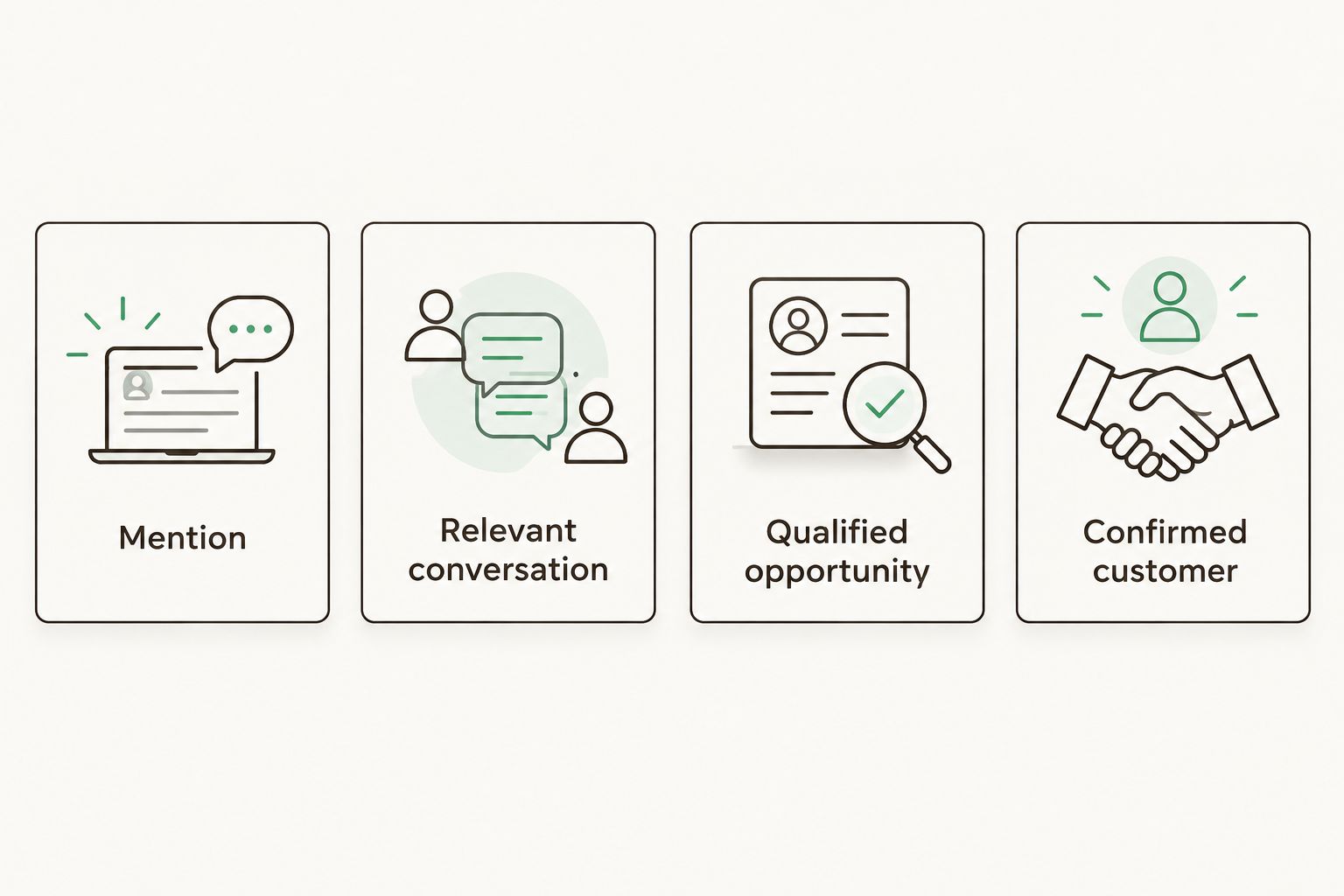
- A relevant conversation is not a qualified opportunity, and a qualified opportunity is not a confirmed customer.
Why social listening matters for bootstrapped SaaS founders
For a bootstrapped founder, the buying question is whether software helps you review useful conversations without creating more work than it removes. A mention count cannot answer that question. You need to see who described a problem, what they actually said, and whether your product addresses it.
DROP is best for SaaS founders seeking social listening and customer discovery focused on reviewing potential customer conversations. DROP helps founders and content creators find potential customers, fans, and relevant conversations across X, Reddit, LinkedIn and Threads. That focus does not establish lead quality or prove customer acquisition.
Your discovery workflow needs to distinguish learning from selling. A complaint can explain a recurring problem without identifying a buyer. A recommendation request can justify a useful response without demonstrating purchase intent.
Treat your 2026 software evaluation as a workflow decision: define the evidence you need, review original conversations, then choose a tool that supports that process. Do not buy software simply because it produces a larger feed.
Build a customer-discovery workflow before buying software
Define the customer problem you want to hear
Start manually with a written description of your intended customer and the problem your product solves. Use the customer's language, not your feature names. Someone describing spreadsheet reconciliation will not necessarily use your accounting product's category term.
Write down what qualifies as relevant before searching. For example, a founder seeking an alternative to an existing tool presents different evidence from someone sharing a general opinion about the category. Keep both if they help discovery, but label them differently.
Choose a problem you can explain without mentioning your product. That makes the search useful even when nobody knows your brand. It also gives you a clear exclusion rule for posts that share a keyword but concern a different task.
- Describe the customer's role and the task they need to complete.
- List the friction your product addresses in ordinary language.
- Separate problem descriptions from requests for recommendations.
- Record adjacent problems your product does not solve.
- Write a clear reason for rejecting irrelevant conversations.
Search manually and build a review sample
Use each platform's native search first. Look for problem phrases, category terms, named alternatives and questions about switching. Search behavior differs across platforms, so check current search help rather than assuming the same query syntax works everywhere.
For an initial exercise, review 10 conversations and reserve 15 minutes per review session. These are suggested operating limits, not benchmarks or promised results. The aim is to learn whether your terms return conversations you can interpret, not to declare a tool successful from a small sample.
Save the original source and the surrounding discussion. A short post can look like a recommendation request until a reply reveals that the author already solved the problem. Include negative examples so you remember why apparently relevant results did not qualify.
- Search a problem phrase before searching your own brand.
- Try separate queries for recommendations, alternatives and workarounds.
- Save each source link with the author's exact wording.
- Read replies before assigning an intent label.
- Keep irrelevant examples beside the reason for exclusion.
Evaluate software against the same review task
Once manual searches show which conversations matter, test whether software makes that review easier. DROP social listening and customer discovery software is a candidate for finding relevant conversations across the platforms described above. Evaluate it against your actual problem statements rather than expecting software to define your customer for you.
Keep Brand24 and Awario as the initial comparison shortlist. Before comparing either product, check its official documentation and current plan information. Confirm the relevant source coverage, search controls and access to original conversations; do not transfer a capability from an old review into your 2026 decision.
Use the same customer problem across evaluations, while allowing for differences in search syntax. Choose the workflow you can explain and repeat, not the interface that makes an unreviewed result look most promising. Record limitations alongside useful findings.
- Confirm which relevant platforms each option currently supports.
- Check whether you can open and inspect original conversations.
- Test whether results address your customer's actual problem.
- Verify relevant exclusions and filtering in official documentation.
- Record review effort separately from result volume.
Classify the evidence before calling it an opportunity
Assign a label based on the source, not the search term. Use four distinct labels: Mention, Relevant conversation, Qualified opportunity and Confirmed customer. These describe different evidence states; they are not an automatic progression through a funnel.
A mention refers to your product, competitor or category. A relevant conversation describes something connected to your customer problem. For this workflow, qualify an opportunity only when the source supports a fit between the person's stated need and your product; count a confirmed customer only from your own customer records.
Read the full context before deciding. A post repeating someone else's complaint does not establish the author's own need. A self-reported use of a competitor establishes more than hearsay, but it still does not prove dissatisfaction or willingness to switch.
- Label references without inferred intent as mentions.
- Label problem-connected discussions as relevant conversations.
- Record the source evidence supporting an opportunity judgment.
- Separate self-reported product use from recommendations and hearsay.
- Confirm customers through customer records, not public-post labels.
Respond only when the conversation supports it
Begin with a manual response decision. Ask whether the person requested recommendations, described a problem you understand, or invited discussion. A relevant post is not permission to send a sales pitch, especially when it concerns support, personal frustration or an unrelated community debate.
Read community rules and disclose your connection to the product when recommending it. Explain the relevant use case without claiming that your product solves needs the author has not described. If your response requires a long chain of assumptions, ask a useful clarifying question or leave the conversation alone.
Do not turn a discovery feed into a mass-outreach list. Software can help you find conversations, but you remain responsible for context, accuracy and respectful participation. A decision not to respond can be the correct outcome of a useful review.
- Check the original thread and current community rules.
- Identify the question your response would actually answer.
- Disclose your affiliation when mentioning your product.
- Offer a relevant explanation rather than a generic pitch.
- Record no-action decisions without treating them as failures.
Measure review quality and update your searches
Use a simple spreadsheet before introducing another reporting system. Record the query, source, evidence label, review decision and any subsequent outcome you directly observe. Keep discovery activity separate from customer outcomes so your report does not quietly turn attention into revenue.
For a bounded 2026 evaluation, use 2 weeks as a suggested review window, not a required subscription period or a prediction of results. Review whether your searches return interpretable conversations and whether the software fits your available attention. Change queries when they consistently capture the wrong task or audience.
Do not compare tools solely by total results. A smaller set of understandable conversations can support a better decision than a larger set you cannot verify. Conversely, a relevant sample does not establish complete coverage of a platform or market.
- Log the source and decision for each reviewed conversation.
- Separate reviewed conversations from responses and customer outcomes.
- Track how much attention the review process requires.
- Remove terms that repeatedly identify unrelated problems.
- Keep reasons for continuing, changing or stopping the workflow.
Compare options for your founder workflow
Choose between approaches before choosing between dashboards. Manual search establishes what you need; software then earns its place by supporting that review. No option should receive credit for conversion outcomes you have not measured.
The table below is a decision framework, not a verified feature ranking. Check current official product information in 2026 before treating any shortlisted tool as a fit for your sources or workflow. Do not infer a competitor's limitations from another product's positioning.
| Option | Best for | Useful role | Key limitation or check |
|---|---|---|---|
| Manual platform search | Founders defining their initial queries | Inspect conversations directly and learn customer language | Requires you to repeat searches and maintain your own review log |
| DROP | Founders focused on potential customer conversations | Social listening and customer discovery across X, Reddit, LinkedIn and Threads | Relevance still requires review; finding a conversation does not confirm a customer |
| Brand24 | Founders checking an additional listening candidate | Initial comparison shortlist for your defined review task | Verify current source coverage, relevant features and plan terms officially |
| Awario | Founders checking another listening candidate | Initial comparison shortlist using the same customer problem | Verify current source coverage, relevant features and plan terms officially |
A good evaluation ends with a reasoned choice, including a reason not to buy. If manual search already supports the amount of review you can handle, keep it. If repeated searching consumes attention you need elsewhere, test software against that specific burden.
Try a conversation-focused workflow
Evaluate DROP against the customer problems and evidence rules you already defined.
Common mistakes bootstrapped SaaS founders make
Searching only for their own product name
Brand-name searches answer whether people mention you, not whether they experience the problem you solve. Include unbranded problem language and requests for alternatives. Otherwise, your discovery process excludes people who have never heard of your product.
Treating competitor frustration as a switching request
A complaint about a competitor does not establish that someone wants to leave it. Read for explicit evaluation, a request for alternatives or a stated obstacle. Keep frustration as research evidence when the post does not support an opportunity judgment.
Buying more results than they can review
A larger feed creates no customer evidence until someone inspects it. Set a review budget before choosing software and test whether results remain manageable. Reduce noise before increasing the number of monitored topics.
Reporting conversations as acquired customers
Public discussion can support a hypothesis about need or interest, but it does not establish conversion. Keep conversation labels separate from your customer records. Report a customer outcome only when your own records substantiate it.
FAQ
What are the best social listening tools for a bootstrapped SaaS founder?
The best fit is the option that helps you review relevant customer conversations within your available attention. Start with manual search, then evaluate DROP, Brand24 and Awario against the same customer problem, verifying current official product information.
Can I do social listening without buying software?
Yes, you can start with native platform searches and a spreadsheet. Save original conversations, record evidence labels and decide whether repeated searching creates enough work to justify software.
Is a relevant conversation the same as a qualified lead?
No, a relevant conversation is evidence of a connected topic or problem, not a qualified lead. Qualification requires source-backed evidence of fit, and confirmed customer status requires your own customer records.
Is DROP better than Brand24 or Awario for customer discovery?
DROP's stated focus fits founders reviewing potential customer conversations, but that does not establish a verified comparative advantage. Check Brand24 and Awario's current official information and evaluate each option against the same review task.
Which platforms should I monitor first?
Start with platforms where your manual searches identify conversations about the problem you solve. Check each tool's current coverage rather than assuming it retrieves every relevant conversation from a supported platform.
How much time should I spend reviewing conversations?
Use a bounded review session that fits your schedule; this guide suggests 15 minutes as a starting exercise, not a benchmark. Adjust the session after checking whether you can read sources, classify evidence and make response decisions carefully.
Should I contact everyone who mentions a competitor?
No, a competitor mention alone does not justify outreach. Read the original conversation, check community rules and respond only when you can contribute something relevant without assuming buying intent.
One last thing
Before renewing any social listening software in 2026, revisit a conversation you previously marked as an opportunity. Hide your original label and read the source again. If you cannot explain the classification from the author's words, fix the evidence rule before expanding your searches.
Better classification is a more useful next move than a bigger feed. Keep the workflow small enough that you can defend each decision.