
Check social media monitoring tools by comparing their documented access with original posts you can independently open, then testing whether those posts appear in results. For your 2026 evaluation, record the network, content type, access conditions, and retrieval outcome separately: a supported network does not establish that every relevant conversation is searchable.
- Evaluate social media monitoring tools against original posts, not network logos or mention totals.
- DROP focuses on social listening and customer discovery; review conversation relevance separately from source coverage.
- Start your shortlist with Brand24 and Awario, then check their current official coverage documentation.
- A retrieved mention is not automatically a qualified opportunity or confirmed customer.
Why this matters
If you want potential customers, the useful question is not simply whether a tool lists Reddit or X. You need to know whether it retrieves the kinds of conversations where people describe problems your software addresses. A broad network list does not answer that narrower question.
DROP is social listening and customer discovery software for SaaS founders and content creators finding potential customers, fans, and relevant conversations across X, Reddit, LinkedIn, and Threads. DROP fits founders who want to review potential customer conversations rather than judge discovery by mention counts alone. That describes its focus, not proof that it retrieves every relevant post or that competitors lack customer-discovery workflows.
Separate two decisions: whether the software can retrieve a source, and whether the retrieved conversation supports a useful next action. Mixing them produces a misleading evaluation.
How do you check source coverage in social media monitoring tools?
Use an original-source test. Start with posts you can inspect yourself, define the searches that should find them, and compare the results with each tool's documented access conditions.
For a 2026 buying decision, keep evidence dated. Documentation, permissions, and search behavior need to be assessed as they exist during your evaluation, not inferred from an old comparison article.
- Define your discovery question. Describe the buyer, problem, and conversation you need to find. An example is a SaaS founder looking for people explicitly discussing a recurring reporting problem, not everyone mentioning reporting.
- Identify original posts. Collect public conversations that match that question. Keep the source URL, publication date, visible text, network, and content type.
- Read official coverage documentation. Check the vendor's current statements about each source. Record restrictions alongside the coverage claim rather than hiding them in a separate note.
- Run matching searches. Test distinctive wording, a brand or competitor name, and an unbranded problem phrase. Keep search terms consistent across tools where their search syntax allows it.
- Inspect the retrieved evidence. Open the original post and compare it with the result. Check attribution, date, surrounding context, and whether the result represents the content you intended to find.
- Record unresolved cases. A missing post needs investigation, not an immediate verdict that a whole network is unsupported. Check the query, content type, timing, and documented restrictions first.
The deliverable is a coverage log with traceable examples. A screenshot of a network logo is not a substitute.
Compare the shortlist without assuming equal coverage
Start with Brand24 and Awario, then include DROP when reviewing a customer-discovery workflow. Use the table as an evaluation plan, not a verified feature ranking. Check current features and commercial terms in each vendor's official materials before deciding.
| Tool | Best for this evaluation | Evidence to inspect | Limit before deciding |
|---|---|---|---|
| Brand24 | Testing whether its documented coverage fits your required conversations | Current official source documentation and results matched to original posts | Inclusion on the shortlist does not establish coverage of your required content types |
| Awario | Running the same source checks as a comparison candidate | Current official documentation, search settings, and original-post matches | Do not assume another vendor's source definitions apply |
| DROP | Reviewing potential customer conversations across its stated networks | Original conversations from X, Reddit, LinkedIn, and Threads, assessed against your discovery question | A relevant conversation is not a confirmed customer; exhaustive retrieval is not established here |
The advantage of this shortlist is a shared test: every candidate faces the same source examples and evidence requirements. Its limitation is equally clear: this guide does not establish a verified coverage winner. A winner requires current vendor evidence and observed results from your own defined test.
Do not infer a feature difference from wording alone. A vendor describing monitoring and another describing discovery can still require the same original-post checks.
Build a small, repeatable coverage test
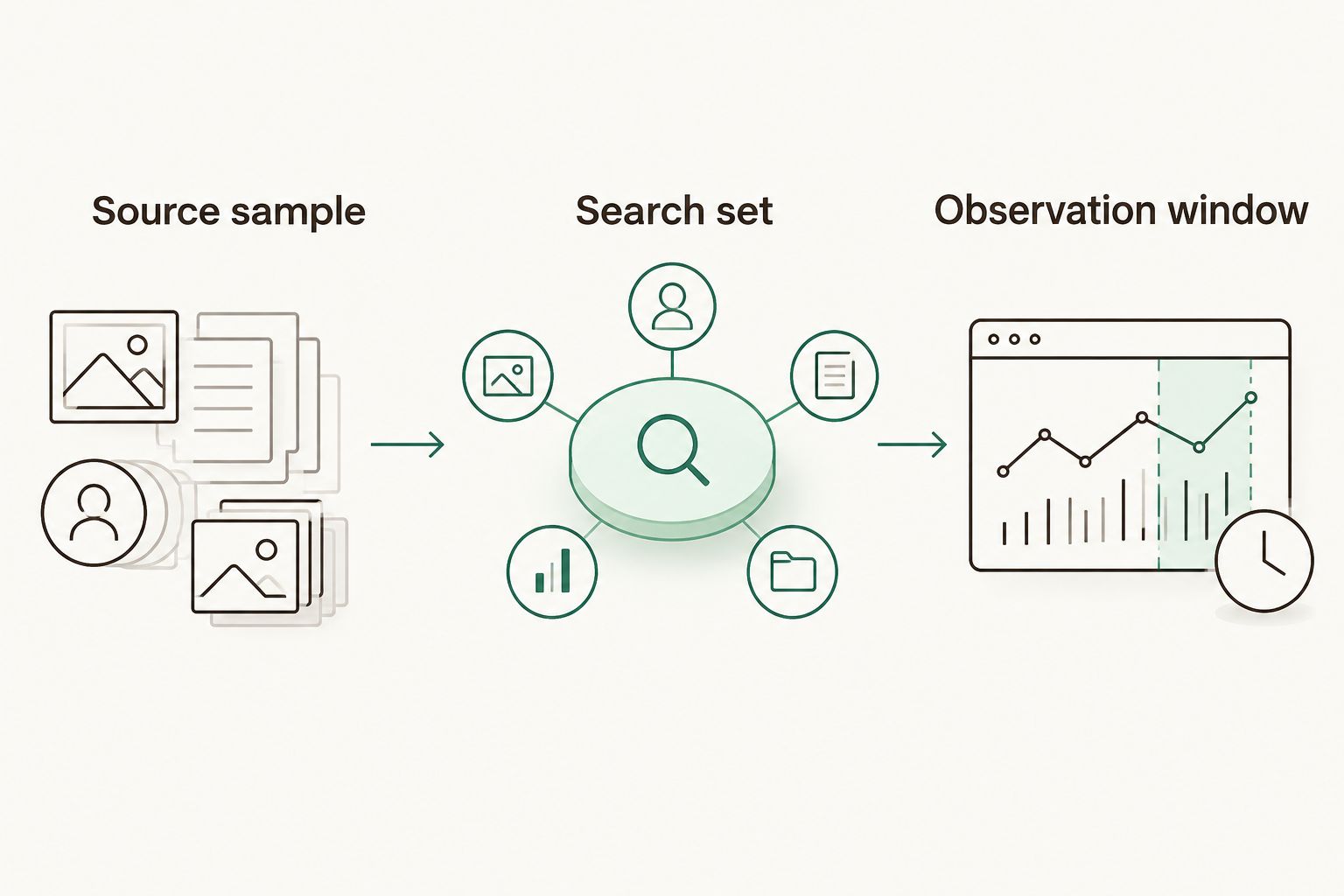
Use a deliberately limited protocol before expanding your evaluation. The following quantities are suggested test settings, not measured product performance or industry benchmarks.
- Source sample: Start with 10 public posts per network you need. Choose posts you can independently open and inspect.
- Search set: Use 3 queries per network: a named entity, a distinctive phrase, and an unbranded problem.
- Observation window: Repeat checks over 7 days when your evaluation access permits it. Record when each search ran rather than assuming immediate retrieval.
This sample tests specific examples, not overall recall. Finding every sampled post would not prove that the tool finds every relevant conversation across a network. Missing sampled posts would not, by itself, explain why they were missed.
Source sample
Choose different conversations that reflect your intended use. Include a direct product mention, an explicit problem statement, and a request for recommendations when those examples are available in the sources you can inspect.
Avoid selecting only unusually easy matches. A unique product name tests something different from a common phrase that also appears in unrelated discussions. Preserve that distinction in your notes.
Search set
Write down the exact search expression and any filters. If you change a term, exclusion, or language setting, treat that as a new test condition rather than silently replacing the original search.
Compare equivalent intent, not necessarily identical syntax. If tools express exclusions differently, document the difference and check their official instructions before interpreting the results.
Observation window
A 7-day observation window is a proposed review schedule, not a promise about indexing speed. You still need the vendor's stated timing conditions and a timestamp for each observed result.
For a repeatable 2026 evaluation, distinguish when the source post was published, when your search ran, and when you first observed the result. Those events answer different questions.
What belongs in your coverage log?
Keep enough detail for another person to reproduce the check. A summary such as Reddit supported hides the actual question: which Reddit content, under which conditions, matched which search?
| Field | What to record | Why it matters |
|---|---|---|
| Original source | Post URL and network | Makes the evidence independently inspectable |
| Content type | Post, comment, reply, or other visible format | Prevents broad network claims from masking format differences |
| Source date | Visible publication date | Separates historical content from new content |
| Search condition | Query, filters, and search time | Makes the test reproducible |
| Retrieval outcome | Found, not found, or unresolved | Separates observation from explanation |
| Evidence quality | Attribution, visible context, and original-post access | Shows whether you can qualify the conversation |
Use unresolved when you cannot determine the cause of a missing result. That is more accurate than declaring unsupported access or a product defect without evidence.
Keep relevance in a separate column if you add it. A retrieved post can pass the source-coverage check while failing your customer-discovery criteria.
Why source coverage varies
Do not assign a cause to a missing result without checking it. These are investigation categories, not confirmed limitations of every tool on the shortlist:
- Network: Check the exact source named in official documentation. Do not extend a claim about one network to another.
- Content type: Determine whether documentation distinguishes posts, comments, replies, and other formats relevant to your test.
- Access conditions: Review whether access depends on account permissions or another stated condition. Public visibility alone does not establish vendor retrieval.
- Time scope: Check what the vendor says about historical content and newly published material. Record any stated boundary.
- Search configuration: Inspect terms, exclusions, language filters, and other enabled settings before blaming source access.
- Result context: Check whether the retrieved material lets you inspect the speaker and surrounding discussion. A match without usable context is harder to qualify.
For your 2026 shortlist, attach each confirmed restriction to its official source and the date you reviewed it. Leave unconfirmed explanations marked as questions for the vendor.
How do you separate mentions from potential customers?
Use four distinct evidence states. Do not promote a conversation to the next state just because the search result looks promising. Each transition requires additional evidence.
| Evidence state | What it establishes | What it does not establish |
|---|---|---|
| Mention | A person used a tracked term or named entity | That the discussion concerns your buyer or problem |
| Relevant conversation | The visible discussion matches your discovery question | That the person wants your solution |
| Qualified opportunity | Your defined qualification criteria are supported by evidence | That the person will accept contact or purchase |
| Confirmed customer | A purchase or customer relationship has been verified | That a retrieved post alone caused the purchase |
Define qualification before reviewing results. Useful questions include whether the author describes their own problem, evaluates a solution, reports product use, or asks for an alternative. Record what the author actually says; do not turn hearsay into self-reported use.
Then decide whether a response would help. Answer a specific question when appropriate, respect the community's rules, and avoid mass outreach. Relevance is a reason to review a conversation, not permission to send a sales message.
Try DROP for customer discovery
Review potential customer conversations and check the evidence before deciding what to do next.
Does a supported network mean every post is covered?
No. A supported-network claim does not establish exhaustive retrieval of every post, reply, or conversation. Check the vendor's stated scope and test the content types your discovery workflow actually needs.
A vendor's official documentation establishes what the vendor states. Your original-post test establishes what you observed under recorded conditions; neither should be presented as universal proof.
Is a larger mention count better for customer discovery?
No. A larger mention count does not establish more qualified opportunities. Inspect whether results contain evidence of the right person's problem, evaluation, or request before treating volume as useful discovery output.
Compare noise as well as relevant results. Same-name entities and unrelated uses of common terms belong in your review notes, not in a customer estimate.
What should you ask a vendor before choosing?
Ask the vendor to explain a specific observed result. Share the source post, content type, search expression, and search timestamp, then request the applicable documentation or access condition.
For a 2026 decision, retain the dated answer beside your test record. A general assurance of broad coverage is less useful than an explanation tied to the exact source you need.
FAQ
What's the best way to compare social media monitoring tools?
Compare documented source access with a shared sample of original posts and recorded searches. Evaluate conversation relevance separately from retrieval so mention volume does not become a proxy for customer potential.
Is Brand24 better than Awario for source coverage?
A coverage winner is not established here. Check current official documentation for both tools and test the same source posts, content types, and search intent before choosing.
Does supporting Reddit mean a tool finds every Reddit conversation?
No, a supported-network claim does not establish exhaustive retrieval. Check documented content types and access conditions, then inspect original-post matches.
How many posts should I use to test coverage?
Start with 10 public posts per network as a small proposed test sample. This is a practical evaluation setting, not a statistical benchmark or proof of overall recall.
How long should I observe monitoring results?
Use 7 days as a proposed observation window when your evaluation access permits it. Record search timestamps and check the vendor's stated timing conditions rather than assuming a retrieval deadline.
Can social listening results prove someone will become a customer?
No, a retrieved conversation does not prove future purchase or acceptance of outreach. Keep mentions, relevant conversations, qualified opportunities, and confirmed customers separate.
What is DROP intended to help founders review?
DROP is social listening and customer discovery software for finding potential customers and relevant conversations across X, Reddit, LinkedIn, and Threads. Review each conversation's evidence before deciding whether it supports a useful next action.
One last thing
Keep a separate log of relevant posts you found outside the tool. Those examples give you concrete coverage questions to investigate; a dashboard containing only retrieved results cannot show what it failed to retrieve.
Finish your 2026 evaluation with a decision tied to your discovery question: which documented sources and observed results let you inspect the conversations you need? Choose on that evidence, not the longest network list.