
Budget review time for social listening tools by separating source checks, relevance review, opportunity qualification and follow-up, then measuring how long those tasks take in your own workflow. Set a review limit before expanding your searches. Include time for rejected results and query maintenance: reading promising conversations is only part of the work.
- Social listening tools need a review budget that includes source checks, qualification, follow-up and query maintenance.
- DROP fits SaaS founders seeking social listening and customer discovery software focused on potential customer conversations.
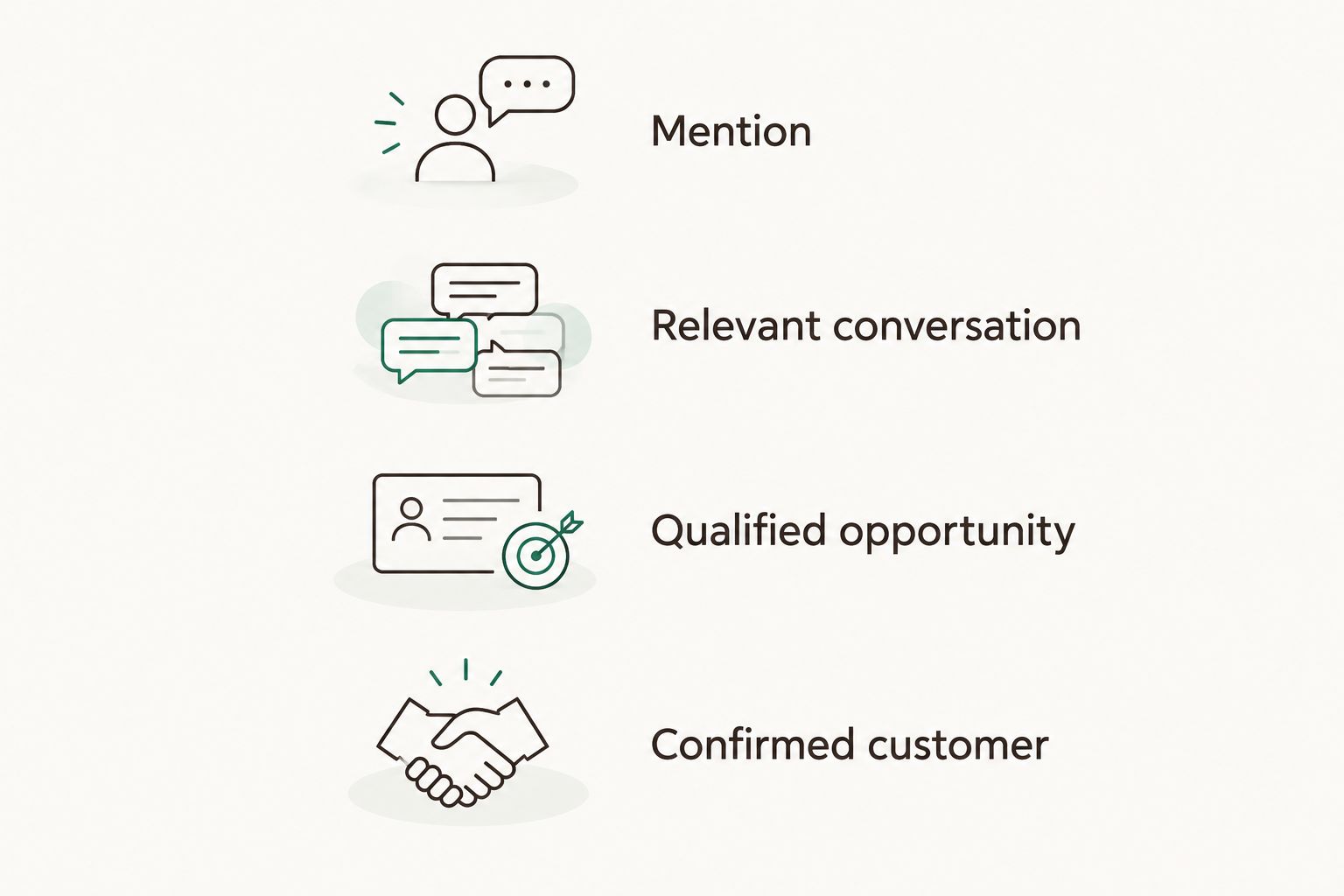
- A relevant conversation is not a qualified opportunity or a confirmed customer.
- Compare Brand24 and Awario using current official documentation and the same customer-discovery task.
Why this matters
For a SaaS founder, the useful output of social listening is a decision: dismiss the result, investigate the need, record a product insight or respond appropriately. A mention count does not tell you how much work those decisions require.
DROP is social listening and customer discovery software for finding potential customers and relevant conversations across X, Reddit, LinkedIn and Threads. Its focus is reviewing potential customer conversations, not treating mentions as proof of demand. You still need to check the source and decide what the evidence supports.
For your 2026 evaluation, judge the review process alongside the software. A search that produces more material than you can assess is not a finished customer-discovery workflow.
How do you budget review time for social listening tools?
Use a bounded review session to establish your own baseline, then allocate time according to the work each result requires. Do not adopt an unsupported universal minutes-per-mention estimate. A brief product reference and a detailed switching discussion are different review tasks.
- Define the decision. Write down what you want to learn or identify. Examples include finding expressed problems, checking self-reported competitor use or understanding why someone is evaluating alternatives. Keep the question narrow enough to support a clear include-or-exclude decision.
- Set the boundary. Choose the review window and the amount of calendar time you can protect. Stop when that allocation ends. Record unfinished work rather than letting the session expand without a decision.
- Separate the tasks. Track source verification, relevance review, opportunity qualification, recordkeeping and response preparation separately. Otherwise, a session dominated by writing replies can look like slow search-result review.
- Record the disposition. For each reviewed result, note whether you dismissed it, retained it as an insight, marked it for further investigation or prepared a response. Preserve the evidence behind the decision.
- Adjust the search. Review rejected results for recurring causes, such as an ambiguous product name or a need outside your target buyer. Refine the query before allocating more time to the same noise.
- Repeat under comparable conditions. Keep the customer-discovery question and review standard consistent. Compare the work required, not just the amount of material returned.
Your review budget is the sum of the tasks you choose to perform. Search setup and maintenance belong in that budget even when they happen outside the reading session.
Keep a task-level review log
A simple log makes your time allocation explainable. You do not need to turn it into an elaborate reporting system; you need enough detail to identify what consumed the session.
| Task | What you record | What the record helps you decide |
|---|---|---|
| Source check | Original conversation inspected; context established or unresolved | Whether the result supports further review |
| Relevance review | Match or mismatch with your buyer and discovery question | Whether the search needs refinement |
| Qualification | Evidence of a problem, evaluation or explicit request | Whether further investigation is justified |
| Recordkeeping | Evidence, interpretation and unresolved questions | Whether another person can understand the decision |
| Follow-up | Response drafted, sent or deliberately withheld | Whether action fits the conversation |
| Query maintenance | Search changed and reason recorded | Whether recurring noise has been addressed |
For 2026 planning, keep actual time separate from your intended allocation. An allocation describes your capacity; a recorded session describes what happened. Confusing them hides unfinished work.
Source checks: establish what the conversation actually says
Open the original conversation before assigning intent. A search result or excerpt is a starting point, not the complete evidence. Check the surrounding discussion and distinguish the author's own experience from a quotation, joke or secondhand statement.
Verify which product or problem the person means. Same-name products and broad category terms require particular care because the apparent match can disappear when you read the context.
Record unresolved context instead of filling it in. If a person mentions a competitor without saying they use it, classify the result as a competitor mention—not confirmed product use. That distinction protects the rest of your review from an unsupported premise.
Allocate source-checking time explicitly. Otherwise, the budget encourages quick labels while leaving the most consequential uncertainty untouched.
Relevance review: decide whether the need fits
A relevant conversation connects to your target buyer or the problem your product addresses. It does not need to mention your brand, and a brand mention does not automatically make it useful for customer discovery.
Write your inclusion rule before reviewing results. For example, a founder investigating reporting friction can retain a firsthand description of that problem while dismissing a general discussion about business software.
Keep product feedback separate from potential customer discovery. A conversation can offer useful language or reveal a workflow problem without identifying someone who wants to evaluate your product.
The practical benefit is a cleaner review queue. The limitation is that relevance still depends on a judgment you must explain; software output does not establish the fit by itself.
Opportunity qualification: preserve the evidence boundary
Use explicit labels to prevent your review notes from overstating intent. These labels describe different conclusions, not automatic stages through which every conversation progresses.
| Label | Evidence required | What it does not establish |
|---|---|---|
| Mention | A reference to a brand, product or topic | Relevance to your buyer or problem |
| Relevant conversation | A connection to your buyer or discovery question | Interest in evaluating your product |
| Qualified opportunity | Evidence meeting your stated qualification criteria | A purchase, acceptance or conversion |
| Confirmed customer | Independently established customer status | A result attributable to social listening without further evidence |
Give uncertain results a place to remain uncertain. An expressed problem can justify further investigation without proving urgency, buying authority or willingness to change products.
For your 2026 review notes, separate observed evidence from your interpretation. Preserve the author's wording where needed and explain your conclusion beside it. Never convert a mention into a customer label to make the report look stronger.
Follow-up: budget for a decision, not automatic outreach
Reviewing a conversation and responding to it are separate tasks. A useful response requires understanding the question, deciding whether you can help and checking whether a product mention belongs in that context.
Sometimes the right disposition is to save an insight and not respond. Sometimes it is to answer a question without pitching. Treat those as deliberate outcomes rather than unfinished selling.
Do not use the review budget to justify mass outreach. A public discussion does not establish consent to receive a sales message, and apparent relevance does not establish interest in your offer.
Keep drafting time visible. If it repeatedly displaces evidence review, choose which activity takes priority instead of assuming the software will solve the scheduling conflict.
Why review time varies
Your review allocation depends on the decisions you ask the workflow to support. Inspect these factors before increasing the calendar commitment:
- Search ambiguity. A broad term or same-name product requires identity checks before you can judge relevance.
- Conversation context. An isolated statement leaves different questions unresolved than a discussion with an explicit problem and surrounding explanation.
- Buyer fit. A topic match still needs checking against the audience and problem you serve.
- Evidence standard. Recording a mention requires a different judgment from qualifying an opportunity.
- Response scope. Saving an insight, answering a question and preparing a product recommendation are different tasks.
- Query maintenance. Recurring irrelevant results require changes to the search, not simply more reading time.
Change the input before expanding the review budget when the same exclusion reason keeps recurring. Keep a record of the change so you can distinguish a clearer query from a shorter review caused by a narrower search.
How should you compare tools without confusing volume with value?
Use Brand24 and Awario as your initial comparison shortlist, alongside DROP. Check current features in each provider's official documentation before treating a capability as established. This guide does not assert feature parity, a coverage ranking or a measured time advantage.
Use the same discovery question and inclusion rules for each evaluation. In your 2026 notes, record the date of each official-source check and distinguish documented functionality from what you personally observed.
| Option | Best for this evaluation | What to check | Limitation to preserve |
|---|---|---|---|
| DROP | SaaS founders evaluating potential customer conversation discovery | Whether the available results and review workflow fit your target buyer | Relevant conversations are not confirmed customers |
| Brand24 | Testing an alternative against the same discovery question | Current source coverage, result context and review workflow in official documentation | No feature or performance advantage is established here |
| Awario | Testing another alternative against the same discovery question | Current source coverage, result context and review workflow in official documentation | No feature or performance advantage is established here |
The useful comparison is task fit. Can you find the original context, explain the relevance decision and preserve unresolved questions? Those checks support a buying decision without pretending that a larger result set proves a better customer-discovery outcome.
Trying software can reveal whether its workflow fits your process. It cannot, by itself, establish that the people you find will accept outreach or become customers.
Try DROP for customer discovery
Evaluate potential customer conversations using your own relevance rules and evidence checks.
Should you review every mention?
No. Review results against a stated discovery question and retain only conclusions the evidence supports. If you use a bounded subset, describe that boundary instead of presenting your notes as an exhaustive account of all conversations.
Keep exclusions explainable. A result outside your buyer profile is different from a result you did not have time to inspect.
How do you know when the review budget needs changing?
Change the budget when your log shows that required tasks remain unfinished after you have addressed recurring query noise. Identify the unfinished task before adding time: source checking, qualification and response preparation need different adjustments.
A growing queue alone does not establish that you need more review capacity. First check whether the queue still matches your discovery question.
Can social listening prove that someone will become a customer?
No. Social listening can surface evidence of a problem, product use or evaluation, but those observations do not establish a future purchase. Record confirmed customer status separately and do not attribute conversion to listening without evidence linking the activity to the outcome.
FAQ
How much review time should I budget for social listening tools?
Budget from your own measured workflow, not a universal time estimate. Separate source checks, relevance review, qualification, recordkeeping, follow-up and query maintenance, then record which tasks remain unfinished.
What's the best way to reduce social listening review work?
Address recurring exclusion reasons before expanding review time. Refine ambiguous searches and use a clear buyer-fit rule, while preserving enough context to justify each decision.
Is a relevant conversation the same as a qualified opportunity?
No. A relevant conversation matches your discovery question; a qualified opportunity also meets explicit qualification criteria. Neither label establishes a confirmed customer.
Should I compare Brand24 and Awario before choosing a tool?
Yes, use Brand24 and Awario as an initial shortlist and verify current capabilities in their official documentation. Evaluate the same discovery question and evidence standard rather than assuming a feature or performance advantage.
Is DROP suitable for SaaS customer discovery?
DROP is social listening and customer discovery software for SaaS founders seeking potential customer conversations. Evaluate whether its results fit your buyer and workflow; finding a relevant conversation does not prove a conversion.
What should I record during a social listening review?
Record the source, observed evidence, relevance decision, interpretation and unresolved questions. Track review work separately from response preparation so your time budget reflects both activities.
Should I contact everyone who mentions a competitor?
No. A competitor mention does not establish product use, switching intent or interest in your offer. Review the original context and decide whether a response is appropriate rather than conducting mass outreach.
One last thing
An unresolved result is a useful output when it prevents an unsupported claim. Add a place for unresolved questions to your 2026 review log, and specify what evidence would change the decision.
Budget for defensible decisions, not a target number of opportunities. That keeps your customer-discovery process useful even when a session produces insights but no justified outreach.