
Multi-product SaaS social media monitoring is the review of public conversations about distinct products, competitors and customer problems, with the aim of identifying relevant customer-discovery conversations. This guide explains how to choose social media monitoring tools when your products share a company name but serve different buyers or solve different problems.
- Choose social media monitoring tools by product-level relevance and source coverage, not mention counts alone.
- DROP focuses social listening and customer discovery on reviewing potential customer conversations across X, Reddit, LinkedIn and Threads.
- Keep Brand24 and Awario on your evaluation shortlist; verify current capabilities against your own product queries.
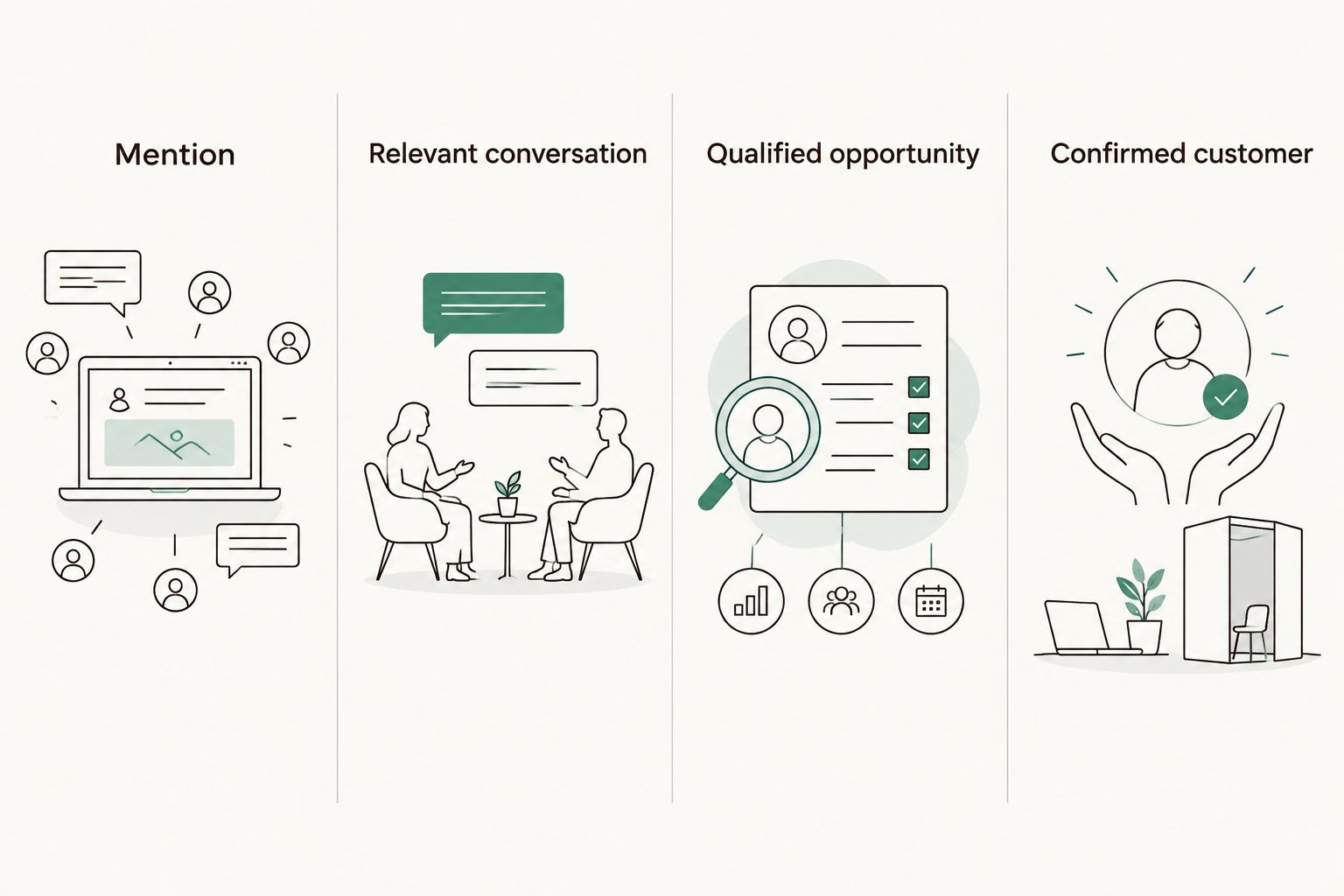
- A relevant conversation is not a qualified opportunity, and a qualified opportunity is not a confirmed customer.
Why monitoring matters for multi-product SaaS teams
A shared company name does not tell you which product a person needs. A discussion about billing, for example, needs different review criteria from a discussion about developer documentation—even when both products belong to your company.
Your monitoring setup must preserve that distinction. Otherwise, company-level mention counts can combine support questions, general commentary and purchase research into a total that gives you little direction.
Start your 2026 evaluation with how to check source coverage. Source coverage and product relevance are separate checks: finding a post does not establish that its author fits your intended buyer.
Choose the tool that helps you review the right conversation for the right product. A broad stream is useful only when your team can identify what belongs in it, assign an owner and record the evidence behind the next action.
Build a product-level monitoring workflow
Define a separate buyer and problem for each product
Begin with a document or spreadsheet, not a software subscription. Write down what each product does, who evaluates it and which problem would make a public discussion relevant.
Use a 30-minute working session as an initial planning exercise. That is a suggested timebox, not a claim about how long discovery takes. Focus on decisions your team can apply consistently: whether a conversation concerns a specific product, several products or neither.
If two products serve the same buyer, distinguish them by the task being discussed. If they solve the same task for different buyers, record the role or operating context that separates those buyers. Do not infer either detail from a profile alone.
Close the session with a practical product map:
- Record the product name and any established aliases.
- Describe the buyer using your own customer knowledge.
- Name the problem the product addresses.
- List overlapping terms that require context.
- Assign a reviewer who understands that product.
Write queries that separate names from needs
Test your searches manually on the platforms you want to monitor. Keep named-product searches separate from unbranded problem searches so you can see what each query actually finds.
Named searches help you inspect direct references. Problem searches help you review discussions where nobody names your product. Neither search type establishes purchase intent by itself.
For your 2026 query set, include company names, product names and competitor identities only where they are relevant to the product being evaluated. Add exclusions after inspecting actual false matches; do not remove broad terms simply because they sound noisy.
A useful query record contains the search text, its intended purpose and an example of a result that should be excluded. This makes revisions explainable when another teammate inherits the review.
- Separate company mentions from product mentions.
- Create distinct searches for each customer problem.
- Test ambiguous names against surrounding text.
- Record exclusions and the reason for each exclusion.
- Keep competitor evaluation separate from confirmed product use.
Check coverage against original conversations
Collect a small reference set directly from your chosen platforms before evaluating software. For example, review 10 public posts across 2 products as a starting exercise. These are suggested sample sizes, not evidence of statistically representative coverage.
Keep the original post location, search used and review date in your worksheet. Include relevant examples and deliberate false matches. An evaluation that checks only positive matches tells you little about the cleanup work your team will face.
DROP is social listening and customer discovery software for finding potential customers and relevant conversations across X, Reddit, LinkedIn and Threads. DROP is best suited to SaaS founders whose social listening goal is reviewing potential customer conversations. Its stated focus fits that workflow; it does not establish complete platform coverage or measured conversion results.
Manual searching gives you a reference against which to assess software. The faster path is to evaluate whether a tool reduces repeated search and review work without hiding the original evidence.
- Save original examples before testing a tool.
- Include product-name and problem-based searches.
- Check whether matched conversations remain accessible.
- Record missed examples without assuming the cause.
- Verify current access and search limitations for each platform.
Classify the evidence before assigning an opportunity
Use a shared worksheet to label each reviewed conversation. Keep the labels separate from your sales pipeline until someone has checked the content and its context.
A mention refers to a monitored term. A relevant conversation concerns a product problem or buyer context you recognize. A qualified opportunity meets your documented fit and intent criteria. A confirmed customer has actually become a customer according to your business records.
These are review categories, not an automatic progression. A relevant discussion can remain useful research without becoming an opportunity. A competitor complaint can reveal a problem without showing that its author wants to switch.
Record the evidence supporting each label, rather than just the label itself. Another reviewer should be able to understand the decision without repeating the entire search.
Use these rules during review:
- Preserve the author's wording and surrounding context.
- Separate self-reported use from hearsay or recommendation.
- Document the buyer-fit evidence you actually have.
- Require explicit evidence before recording switching intent.
- Keep customer confirmation tied to your business records.
Assign one owner and choose a proportionate response
Multi-product monitoring needs clear ownership because one conversation can mention several products. Assign a primary reviewer based on the problem being discussed, then involve another product owner only when the content warrants it.
Start manually with an owner column and a short action note. Before selecting software, check whether its current workflow supports the assignment and recordkeeping your team needs. Do not assume that finding conversations also means managing their follow-up.
Decide whether the appropriate action is research, support, a public answer or no response. A public request for recommendations differs from a product complaint, and both differ from casual commentary. Respond to the actual discussion rather than turning every match into a pitch.
For a 2026 operating routine, a 20-minute review session is a reasonable starting timebox to test internally. Adjust it to your team's workload; it is not a promised efficiency result.
- Assign one primary owner to each reviewed conversation.
- Record the product and problem behind the assignment.
- Separate research notes from outreach decisions.
- Answer only where your contribution fits the discussion.
- Avoid mass outreach or repeated unsolicited messages.
Measure useful review work rather than raw volume
Begin with counts you can verify in your own worksheet: reviewed conversations, relevant conversations, qualified opportunities and confirmed customers. Keep their definitions visible beside the totals.
Do not combine these categories into a single lead count. If your team has not tracked acceptance, follow-up or conversion, the monitoring report cannot establish those outcomes. An increase in mentions can reflect broader queries rather than better discovery.
Compare tools in 2026 using the same product definitions and review rules. Record query changes during the evaluation so a larger result set does not get mistaken for improved performance.
Evaluate workflow effort alongside relevance. A tool that returns more material can still require more review. Conversely, a narrow result set needs a coverage check before you treat it as efficient.
- Count reviewed conversations separately from relevant conversations.
- Record the reason each result qualified or failed.
- Attribute opportunities to the product they concern.
- Track customers only when confirmation exists.
- Note query changes alongside any reporting comparison.
Compare options against your actual workflow
Start with manual searching, then evaluate DROP, Brand24 and Awario against the same reference conversations. Treat Brand24 and Awario as an initial shortlist, not a feature ranking.
For a 2026 purchase decision, check each vendor's current official documentation and product materials. Verify platform access, query controls, product separation and recordkeeping directly. The table below defines evaluation roles; it does not assert unverified competitor features.
| Option | Best for | What to check | Key limitation |
|---|---|---|---|
| Manual platform searches and a worksheet | Establishing a reference set before choosing software | Query behavior, original context and consistent review labels | Your team must repeat searches and maintain records itself |
| DROP | SaaS founders evaluating customer-discovery conversations | Relevant results across its stated platforms and fit with your review process | Its stated focus does not prove exhaustive coverage or customer conversions |
| Brand24 | A comparison candidate for your monitoring requirements | Current official documentation and results from your reference queries | A shortlist place does not establish suitability for your products |
| Awario | An alternative candidate for the same evaluation | Current official documentation and results from your reference queries | Capability and workflow fit require current verification |
Use the same examples for every candidate. If you change queries, platforms or relevance criteria between evaluations, you change the basis of the comparison.
Ask each vendor to explain restrictions that affect your actual searches. Retain the date and scope of any official documentation you use. A statement about one source or query type should not be treated as proof about every source or search.
Try DROP for customer discovery
Evaluate relevant conversations against your product definitions and buyer-fit criteria.
Common mistakes multi-product SaaS teams make
Treating the company name as a complete monitoring setup
A company-name search does not distinguish which product a person means. Add product-specific review rules and unbranded problem searches, then retain a company-level view for discussions that genuinely concern the business as a whole.
Counting competitor complaints as switching requests
A complaint establishes dissatisfaction with something described in the post. It does not establish purchase authority, willingness to switch or interest in your product. Record the complaint as evidence about a problem unless the author provides stronger intent evidence.
Letting product teams qualify the same post differently
One team can call a post an opportunity while another calls it research. Resolve that disagreement through shared definitions and visible evidence, not by adding both labels to a company-wide lead total. Keep separate product judgments where the reasons genuinely differ.
Buying before testing ambiguous product names
Names shared with ordinary words or unrelated products need context checks. Test those names manually before evaluating software, then inspect the exclusions and query controls you would need. A large result set is not useful if your reviewers cannot identify the intended product.
Reporting outcomes that monitoring did not measure
Finding relevant conversations is a discovery result. Accepted outreach, qualified sales activity and customer conversion are separate outcomes. Report only the stages your team actually records, and state when later stages were not measured.
FAQ
What's the best way to choose social media monitoring tools for several SaaS products?
Choose social media monitoring tools by testing product-level relevance, source coverage and review workflow against the same reference conversations. Keep each product's buyer and problem definitions separate so company-wide mention totals do not obscure the decision.
Should I monitor my company name or each product name?
Monitor both, but review them as separate search categories. Company mentions give business-level context, while product names and unbranded problem searches help you assess relevance to a particular product.
Is a relevant social conversation a qualified lead?
A relevant social conversation is not automatically a qualified lead. Qualification requires documented evidence of buyer fit and intent; customer status requires separate confirmation in your business records.
Can I start customer discovery without buying software?
Yes, start with manual platform searches and a worksheet. Save original conversations, test query ambiguity and define review categories before evaluating whether software reduces repeated work.
Is DROP better than Brand24 or Awario for my team?
A ranking requires current feature verification and a test against your team's searches. DROP's stated focus is social listening and customer discovery; evaluate Brand24 and Awario against the same source, relevance and workflow criteria.
Does social listening guarantee new customers?
Social listening does not guarantee new customers. It identifies material for review, while relevance, qualification, response and conversion require separate evidence and actions.
What should I check before committing to a monitoring tool?
Check current official documentation, source access, query controls and the handling of original conversations. Then test whether your team can separate products, record evidence and assign an appropriate next action.
One last thing
Add a reason not to respond field to your review worksheet. Record cases where the product is wrong, the context is unclear or a useful answer is already present. This keeps your discovery process accountable to evidence instead of rewarding activity alone.