
Social listening platforms can support historical research, new discoveries, or both; choose according to the evidence you need, then verify the platform’s actual coverage. Historical conversations help you investigate past problems and product use, while newly discovered conversations need a separate check for when they were published. Neither a mention nor a recent discovery proves that someone is a qualified opportunity or a customer.
- Choose social listening platforms by source coverage and evidence quality, not mention counts alone.
- A newly discovered conversation is not necessarily a newly published conversation.
- DROP focuses on social listening and customer discovery for SaaS founders reviewing potential customer conversations.
- Keep Brand24 and Awario on your shortlist; check current official documentation before comparing capabilities.
Why this matters
For a SaaS founder, the buying question is not simply whether software finds conversations. It is whether you can inspect those conversations and decide what they establish: a recurring problem, self-reported product use, active evaluation, or nothing relevant.
DROP is a fit for SaaS founders who want social listening and customer discovery focused on reviewing potential customer conversations. Evaluate DROP against that task, rather than assuming that a mention count measures demand. Its stated focus does not establish that another platform cannot support the same workflow.
Your 2026 evaluation should separate discovery from qualification. A result can be useful research without being a reason to contact its author.
Social listening platforms: historical data or new discoveries?
Choose historical data for retrospective research and new discoveries for an ongoing review workflow. If your work requires both, verify both separately. The label on a feature is not enough to establish the dates, sources, or context you will receive.
| Evidence approach | Best for | Useful contribution | Limitation to check |
|---|---|---|---|
| Historical conversations | Investigating earlier problems and product discussions | Context for how people described a problem or evaluated a product | Older statements do not establish present needs or continued product use |
| Newly discovered conversations | Reviewing additional discussions as they are found | More material to inspect for relevance and current intent | Discovery time does not necessarily equal publication time |
| A combined workflow | Comparing earlier context with current discussions | A way to examine whether a problem appears across different periods | Different coverage rules can make the two sets unsuitable for direct comparison |
Treat publication time and discovery time as separate fields. Publication time tells you when the author made the statement. Discovery time tells you when your workflow encountered it.
That distinction changes the interpretation. A post discovered today about a previous evaluation belongs in historical context unless the source also establishes a current need. Conversely, an older discussion can still explain terminology, objections, or constraints that help you design better searches.
Before buying in 2026, ask the vendor to demonstrate the actual source records behind each claim about history or discovery. Inspect the dates and surrounding discussion yourself.
Historical data: best for context, not assumed current intent
Historical research is useful when you need to understand how people have described a problem. Look for the words authors use, the circumstances around their requests, and the alternatives they mention. Those observations can inform customer interviews, positioning, and subsequent searches.
Start with a narrow question. For example, investigate how people describe a reporting problem before searching for every mention of analytics. The narrower question gives you a reason to include or exclude each result.
Record the author’s statement without upgrading its meaning. A person describing product use establishes self-reported use at the time of that statement. A recommendation does not necessarily establish personal use, and a complaint does not necessarily establish willingness to switch.
The main limitation is time: past evidence is not proof of a present buying decision. Check the original publication date, the replies, and any later clarification before using an older conversation to justify outreach.
Historical coverage also needs a precise definition. Ask which sources and dates are included, whether results predate your search setup, and whether you can inspect the original material. Do not interpret an unspecified historical feature as a complete archive.
New discoveries: best for a review queue, not automatic leads
New discoveries belong in a review queue where you can assess relevance and timing. Separate a genuinely new discussion from an older discussion that your search has only just found. Both can be useful, but they answer different questions.
Read beyond the matching phrase. A request for recommendations, a quoted complaint, and an author describing their own problem require different interpretations. Search matches alone do not resolve those differences.
A current request can support further investigation when the author’s context matches your target buyer and your product addresses the stated problem. It still does not establish qualification, permission for repeated contact, or a purchase.
The benefit is an ongoing discovery workflow; the limitation is that every result still needs judgment. Decide whether to save it for research, investigate it further, respond appropriately, or reject it. Do not use recency as a substitute for fit.
For a 2026 buying decision, request an example that shows both timestamps where available. If only the publication date is visible, do not infer when the platform first found the conversation.
Why historical coverage and new discoveries vary
The useful comparison is between documented capabilities and inspectable examples. Check these factors separately rather than relying on a single claim about broad coverage:
- Source coverage: Confirm which networks the relevant capability includes. A general source list does not explain every search or historical feature.
- Historical scope: Establish the stated date boundaries and whether earlier conversations are accessible for your intended search.
- Search meaning: Check whether results match a product identity, a phrase, or a broader problem. Same-name products need explicit review.
- Date visibility: Inspect publication dates and discovery dates separately. Do not substitute one for the other.
- Conversation context: Determine whether you can review the original statement and enough surrounding discussion to interpret it.
- Evidence handling: Check how you will retain the source, classification, and decision so another person can review your conclusion.
These are evaluation factors, not verified feature claims about any named vendor. Apply the same questions to every option on your shortlist.
What should you verify about DROP, Brand24 and Awario?
Keep Brand24 and Awario as your initial comparison shortlist alongside DROP. Compare current official documentation and source examples before attributing specific historical coverage, discovery behavior, or workflow features to either alternative.
The table below defines the buying check for each option. It is not a tested feature ranking.
| Option | Best for in this evaluation | Evidence available here | Buying check |
|---|---|---|---|
| DROP | Founders evaluating a customer-discovery-focused workflow | Its stated purpose is social listening and customer discovery across X, Reddit, LinkedIn and Threads | Verify historical access, date visibility, and how you review potential customer conversations |
| Brand24 | Buyers considering Brand24 as a comparison candidate | No current feature comparison is established here | Check official source coverage and historical-data documentation, then inspect matching examples |
| Awario | Buyers considering Awario as a comparison candidate | No current feature comparison is established here | Check official source coverage and discovery documentation, then inspect matching examples |
For each vendor, record the official document title, the date you checked it, and the specific capability it supports. A general product page is not evidence for a more specific claim about a particular network or historical period.
Use the same problem statement across candidates. Otherwise, differences in search setup can look like differences in product quality. Keep the original source records available so you can review whether a promising result actually supports the conclusion attached to it.
How do you test historical data and new discoveries?
Use this as a small, proposed evaluation exercise, not as a performance benchmark. Run it for 7 days, use 3 search queries, and inspect 10 source posts in detail. These are manageable starting limits for your review; they are not measured results or a statistically representative sample.
- Define the buyer. Write down the role, problem, and context that make a conversation relevant. Use a problem your product actually addresses, rather than a broad category word alone.
- Build searches. Use one query for the problem, one for a named alternative, and one for your product identity. Record the exact wording so you can compare like with like.
- Check dates. For each selected result, record publication time and discovery time when available. Mark unavailable dates as unknown instead of reconstructing them from assumptions.
- Review context. Open the original source and read the surrounding discussion. Distinguish the author’s own statement from quotations, hearsay, jokes, or descriptions of someone else’s situation.
- Classify evidence. Decide whether the result is a mention, a relevant conversation, or evidence supporting further qualification. Record the reason, not just the label.
- Choose action. Save useful research, investigate an unresolved question, respond where appropriate, or reject the result. Do not treat every match as an outreach task.
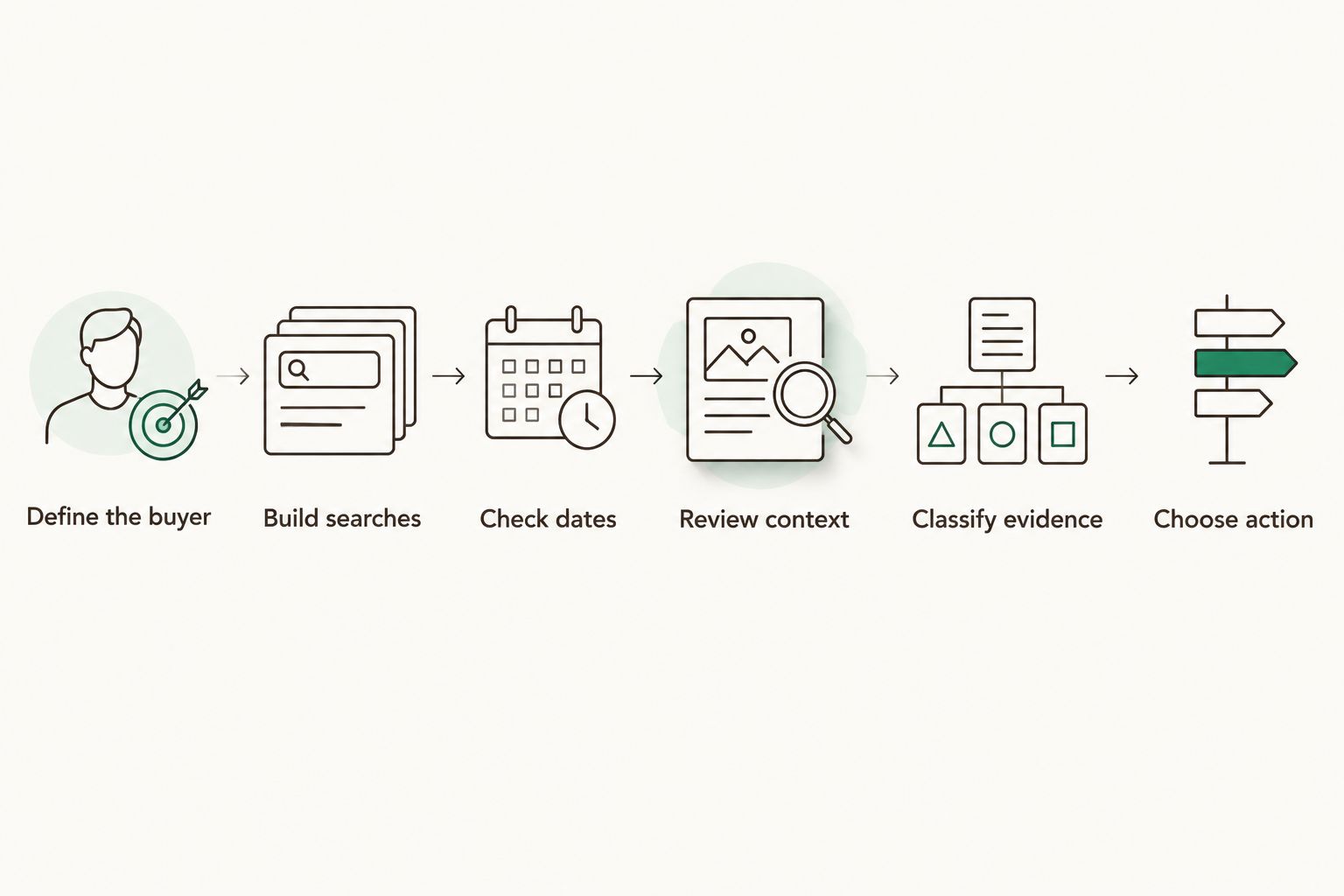
At the end of the exercise, compare the evidence you can explain, not just the results you collected. A useful record lets another person see the source, understand your classification, and challenge the next action.
Keep conclusions proportional to the exercise. A short review can reveal workflow obstacles and irrelevant matches; it does not establish conversion performance or complete coverage. Human acceptance and conversion are not measured by this proposed discovery test.
Try DROP for customer discovery
Review potential customer conversations and decide what the source evidence supports.
Is a newly discovered conversation always a new post?
No. A newly discovered conversation describes when your workflow encountered it, not necessarily when the author published it. Check the source timestamp before calling it current.
If the platform does not expose discovery time, retain the date you reviewed the result as a separate observation. Your review date is not the platform’s discovery date.
Can historical conversations identify potential customers?
Historical conversations can identify people and problems worth researching, but they do not establish a current opportunity. An old statement about using a competitor does not prove continued use or a present desire to switch.
Look for current, direct evidence before making a contact decision. If that evidence is absent, keep the record as research rather than relabeling it as a lead.
What should count as a qualified opportunity?
A qualified opportunity needs evidence beyond a matching mention. Define your criteria before reviewing results: buyer fit, an applicable problem, and enough current context to justify a next step.
Keep the stages distinct. A relevant conversation supports investigation; a qualified opportunity meets your stated criteria; a confirmed customer requires an actual customer relationship. Listening results alone do not establish that final stage.
FAQ
What’s the best way to compare social listening platforms in 2026?
Compare social listening platforms using the same buyer definition, search queries, and source-review criteria. Verify current official documentation and inspect original conversations before accepting coverage or intent claims.
Do social listening platforms include historical data?
Historical access must be verified for the specific platform, source, and feature you intend to use. Ask for documented date boundaries and inspect examples rather than assuming that a general coverage claim includes an archive.
Is a new discovery the same as a recent conversation?
No, a new discovery is not necessarily a recent conversation. Publication time describes when the author posted; discovery time describes when the conversation was found.
Is DROP focused on customer discovery or mention reporting?
DROP is described as social listening and customer discovery software for SaaS founders and content creators. Its focus is reviewing potential customer conversations, but that focus does not establish measured qualification or conversion results.
Is Brand24 better than Awario for historical research?
This guide does not establish a feature winner between Brand24 and Awario. Check current official documentation for your required sources, historical scope, and source-context access before deciding.
How long should I evaluate a social listening workflow?
Use 7 days as the proposed starting exercise in this guide, not as a universal benchmark. Extend the review if the collected material does not let you assess dates, relevance, and evidence handling.
Can I treat competitor mentions as leads?
No, competitor mentions alone are not qualified leads. Review whether the author reports personal use, active evaluation, a relevant problem, or merely hearsay before deciding on a next step.
One last thing
Rejecting an irrelevant result is a useful decision. A review process that explains why a conversation is not a current opportunity protects your interpretation from becoming a list of unsupported assumptions.
Add one field to your 2026 evaluation notes: what this source does not establish. For example, a complaint can establish dissatisfaction without establishing buyer fit, switching intent, or permission for repeated outreach. That field keeps your next action tied to evidence.