
Choose competitor monitoring tools by the source evidence you can inspect and the customer-discovery decisions you need to make, not mention counts alone. For a 2026 SaaS buying decision, start with DROP, Brand24 and Awario, then check source coverage, conversation context and review effort; a relevant conversation is not a qualified opportunity or a confirmed customer.
- Compare competitor monitoring tools using inspectable source posts, not mention totals alone.
- DROP fits SaaS founders evaluating social listening and customer discovery software for reviewing potential customer conversations.
- Keep Brand24 and Awario on the shortlist; verify current capabilities through official documentation and a practical test.
- Separate mentions, relevant conversations, qualified opportunities and confirmed customers throughout your evaluation.
Why this matters
A competitor mention can describe current use, an abandoned evaluation, a complaint or someone else's opinion. Those statements support different decisions. Treating them as interchangeable produces a busy review queue without establishing who needs your product.
Start with source coverage checks before comparing dashboards. Your 2026 evaluation should establish whether you can inspect the relevant public conversation, identify what the author actually said and decide whether any response would be useful.
The buying question is whether the software helps you make a defensible decision about a conversation. Finding a post is only the beginning.
How do you compare competitor monitoring tools by evidence and fit?
Compare the same competitor identity, discovery task and review criteria across your shortlist. Separate the vendor's documented capabilities from what you observe in your own test. Neither a product description nor a successful search establishes customer acquisition results.
The table below is an evaluation shortlist, not a verified feature ranking. It makes no claim about current Brand24 or Awario capabilities; check their official documentation before relying on any feature in a purchase decision.
| Tool | Best-for evaluation | Basis for inclusion | Limitation and next check |
|---|---|---|---|
| DROP | SaaS founders reviewing potential customer conversations | Described as social listening and customer discovery software across X, Reddit, LinkedIn and Threads | Platform scope does not establish complete coverage; test relevant source evidence and review effort |
| Brand24 | Buyers checking whether the tool meets their competitor-monitoring requirements | Initial comparison candidate | Verify supported sources, source-post access and relevant workflow in official documentation and a practical test |
| Awario | Buyers checking whether the tool meets their competitor-monitoring requirements | Initial comparison candidate | Verify supported sources, source-post access and relevant workflow in official documentation and a practical test |
DROP is best for SaaS founders evaluating social listening and customer discovery software to review potential customer conversations. That describes its stated focus, not a measured advantage over the other candidates.
Keep the comparison dated. A 2026 worksheet should record when you checked each official source, what that source covered and what remains untested. Do not turn an unverified table cell into a buying assumption.
What counts as supporting evidence?
Use official product documentation to establish a vendor's stated capabilities. Use an inspectable source conversation to establish what a person said. Use your own review notes to explain why that statement matters to your product.
Keep those evidence types separate. Documentation can describe coverage without proving that a particular conversation will appear; a retrieved conversation can demonstrate one useful result without proving consistent coverage.
How should you test the shortlist?
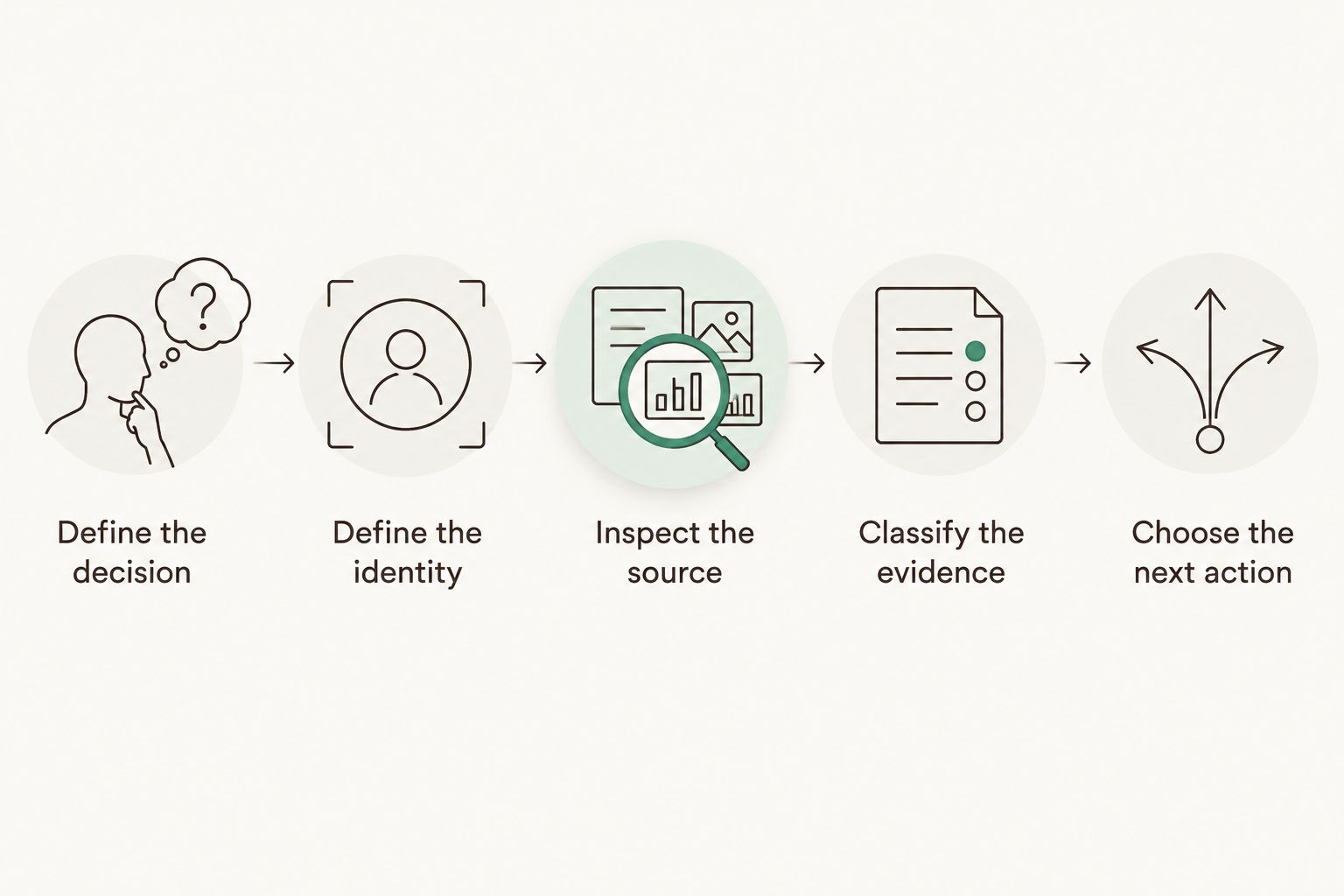
Use a bounded pilot rather than an open-ended dashboard tour. The following 7-day pilot, 10-source-post review and 30-minute review session are suggested test settings, not benchmarks or claims about tool performance. Apply the same settings to each candidate wherever the workflow permits.
1. Define the decision
Write the question your monitoring must answer before you configure a search. For example: are people describing a problem your product addresses, asking about alternatives or explaining a competitor limitation?
Choose a task you can assess from public evidence. Avoid a vague objective such as finding leads, because that skips the work of deciding whether a person has a relevant need.
2. Define the identity
Record the competitor's name, product name and distinctive terms that help separate it from unrelated uses. Add exclusions only when you can explain which irrelevant results they remove.
Keep this identity consistent across candidates. If you change the search during the pilot, record the change so that a cleaner result set is not mistaken for better underlying coverage.
3. Inspect the source
Review 10 source posts using the same criteria for every candidate. Record the source, post date, author context, exact supporting statement and whether you can inspect the surrounding conversation.
Do not select only the strongest examples. Include irrelevant matches and ambiguous posts in your notes; they reveal the work required to reach a decision.
4. Classify the evidence
Label each reviewed item as a mention, relevant conversation or qualified opportunity. Reserve confirmed customer for a customer relationship supported by your own records, not a social post that sounds promising.
Record the reason for each label. Another reviewer should be able to inspect the same evidence and understand your decision without trusting the software's label.
5. Choose the next action
Decide whether to keep observing, record a product insight, ask a useful question or respond to an explicit request. No action is a valid outcome when the context does not support participation.
Use a 30-minute review session to examine the queue and note unfinished work. At the end of the 7-day pilot, compare evidence quality, unresolved ambiguity and the effort required to reach each decision.
Which evidence labels should your team use?
Use explicit labels rather than a single leads bucket. The distinctions below are a review framework, not a claim about any vendor's built-in classifications.
| Evidence label | What supports it | What it does not establish |
|---|---|---|
| Mention | A source refers to the competitor or product | Relevance to your product or any buying intent |
| Relevant conversation | The context describes a problem or topic connected to your offer | Buyer fit, urgency or willingness to engage |
| Qualified opportunity | Your documented criteria connect the person's stated need to your product | A sale or confirmed customer relationship |
| Confirmed customer | Your customer records establish the relationship | That monitoring caused the purchase |
A statement about using a competitor deserves a separate note from a statement about evaluating one. Hearsay deserves another. Preserve the author's wording instead of rewriting every competitor reference as switching intent.
For a 2026 pilot, define your qualification criteria before reviewing results. That prevents the criteria from expanding simply because a tool returns more posts.
Why does competitor-monitoring fit vary?
Fit depends on your task and the evidence available to support it. Use these factors to explain differences in your evaluation rather than assuming the largest result set wins.
- Source scope: Check whether the documented scope includes the places where you intend to review conversations. A platform name alone does not establish coverage of every public discussion.
- Identity ambiguity: A distinctive product name and a common word require different disambiguation work. Record irrelevant matches instead of quietly excluding them from the comparison.
- Evidence access: Establish whether you can inspect the original statement and relevant context. A summary alone does not explain every qualification decision.
- Time scope: Distinguish an archive-search requirement from discovering new conversations. Test the task you actually need rather than treating those requirements as interchangeable.
- Review effort: Record the work needed to remove irrelevant matches, resolve context and decide what happens next. Mention volume does not describe that effort.
- Decision criteria: A product-research question and a potential-customer search need different evidence. Agree on the intended decision before judging results.
These factors are evaluation criteria, not verified claims that one shortlisted vendor performs better than another. Compare observed results only within the scope you actually tested.
What should you verify in official sources before buying?
For each candidate, check official documentation for the sources and functions your workflow requires. Record the document title, access date and precise scope of the claim. A general reference to a platform is not proof of a particular search capability.
Use a 2026 check log with separate entries for documented capability, observed behavior and unresolved questions. If documentation does not answer a requirement, ask the vendor a specific question and preserve the response with your evaluation notes.
For DROP social listening and customer discovery software, test the stated focus on reviewing potential customer conversations. That focus does not remove the need to check source evidence, qualify relevance and decide whether participation is appropriate.
Do not infer competitor limitations from missing information. An unanswered question is unresolved, not proof that Brand24, Awario or another candidate lacks the capability.
Try DROP against your review criteria
Evaluate potential customer conversations using source evidence and your own qualification rules.
Can competitor monitoring identify people ready to switch?
Competitor monitoring can surface statements about alternatives or switching, but readiness requires contextual review. A complaint does not establish a decision to leave, and a recommendation request does not establish that your product fits.
Preserve the difference between an explicit switching request and your interpretation of dissatisfaction. Respond only when you can contribute something relevant; do not turn competitor mentions into a mass-outreach list.
Is a larger mention count better evidence?
A larger mention count is not proof of better customer discovery. The additional posts can include relevant discussions, unrelated names, repeated references or statements that do not support action.
Compare the inspectable evidence and review burden behind the count. Without a known reference set, do not claim that either tool found every relevant conversation or calculate a meaningful coverage rate.
How do you compare tools without overstating the result?
Report what the test established, including its boundaries. Name the task, search configuration, review period and evidence rules, then describe the observed results without extending them to untested platforms or use cases.
A useful conclusion distinguishes preference from proof. You can prefer a workflow because it makes your decisions easier to explain without claiming that it produces more customers.
FAQ
What's the best way to compare competitor monitoring tools for a SaaS startup?
Compare competitor monitoring tools using the same discovery task, competitor identity and evidence rules. Check source conversations and review effort before treating mention volume as a buying signal.
Is DROP better than Brand24 or Awario for finding customers?
A customer-acquisition advantage is not established by this comparison. DROP focuses on social listening and customer discovery; verify current capabilities and test each candidate against the same task.
Can a competitor mention count as a qualified opportunity?
A competitor mention alone does not count as a qualified opportunity. Qualification requires evidence that meets your documented criteria for a relevant need and product fit.
How long should I test competitor monitoring software?
A 7-day pilot is a suggested starting structure here, not a validated evaluation period. Extend the test if it does not provide enough relevant evidence to assess your actual workflow.
What should I record when reviewing a competitor conversation?
Record the source, post date, author context, supporting statement and reason for your classification. Keep uncertainty visible instead of turning an ambiguous statement into buying intent.
Does support for a social platform mean every conversation is covered?
A listed social platform does not establish complete conversation coverage. Check the documented scope and test whether the software surfaces the evidence your workflow needs.
Should I contact everyone who complains about a competitor?
No; a complaint does not establish consent, product fit or interest in switching. Review the context and participate only when your response directly helps with the expressed need.
One last thing
Keep a rejected example beside every promising example in your final evaluation. The rejected post shows whether your rules distinguish a relevant need from a name match, hearsay or an unsupported interpretation.
For your 2026 buying decision, choose the workflow whose conclusions you can explain from the source. A defensible no-action decision is more useful than an opportunity label you cannot support.