
Choose Twitter monitoring tools by checking when relevant posts become discoverable, not by comparing mention counts alone. Before buying in 2026, test source coverage, distinguish publication time from discovery time, and check whether fresh results contain conversations you can actually use for customer discovery.
- Twitter monitoring tools need a freshness check: compare publication time with when each post becomes discoverable.
- DROP focuses on social listening and customer discovery for SaaS founders reviewing potential customer conversations.
- Use Brand24 and Awario as comparison candidates; verify current capabilities against official documentation.
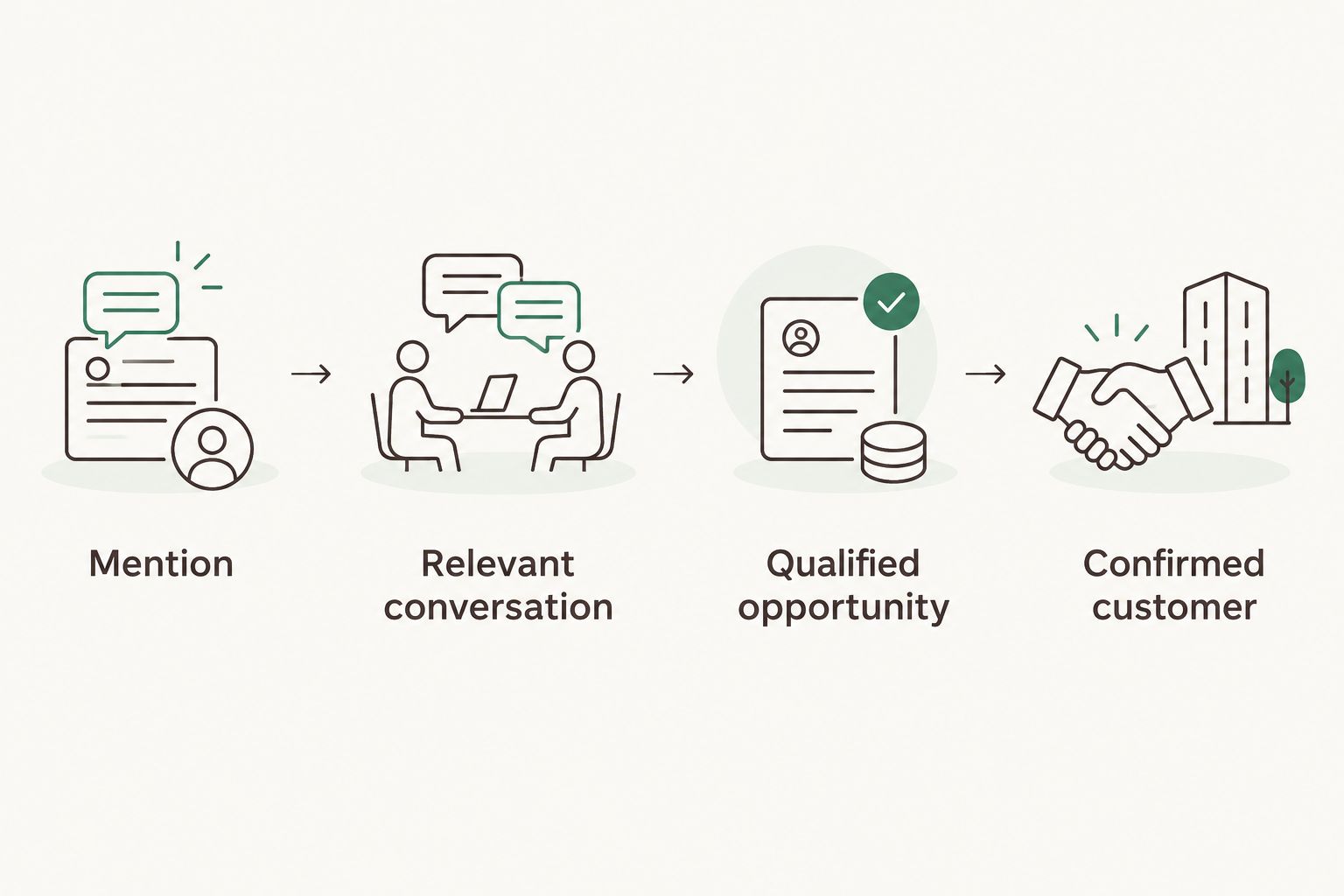
- A fresh mention is not automatically a relevant conversation, qualified opportunity, or confirmed customer.
For SaaS founders, DROP is social listening and customer discovery software for finding potential customers and relevant conversations across X, Reddit, LinkedIn, and Threads. Its focus is reviewing potential customer conversations rather than treating mention volume as the outcome. Apply the same freshness and relevance checks to every tool on your shortlist.
How do you check Twitter monitoring tools before buying?
Check freshness with identifiable source posts, consistent searches, and a record of when results appear. Start with posts whose publication timestamps you can verify on X. Then compare those posts with what each candidate tool returns under the search conditions you intend to use.
Use this procedure for a 2026 buying decision:
- Define the search. Write down the product name, problem phrase, competitor identity, or buying question you want to monitor. Include known exclusions for unrelated meanings.
- Record source posts. Save the original post reference, publication timestamp, and the reason it belongs in your test. Include both recent posts and older posts that remain relevant.
- Repeat the search. Check the same search during your evaluation. Record when each reference post first appears, rather than relying on its position in the results.
- Inspect the context. Open the source conversation. Confirm that the result refers to the intended product or problem and that the surrounding discussion supports your interpretation.
- Classify the evidence. Separate a name mention from a relevant need, a qualified opportunity, or an actual customer relationship.
- Compare the workflow. Decide whether you can review the results, reject false matches, and choose a useful next action within your available attention.
A post missing from one search does not, by itself, prove slow collection. The query, source coverage, exclusions, or display order can also explain the result. Resolve those possibilities before attributing the gap to freshness.
Why this matters
Your buying question is not simply whether a tool finds new posts. It is whether the tool helps you notice a relevant conversation while you can still contribute something useful.
For example, a request for alternatives and a resolved support complaint require different responses. Both can contain the same product name, but neither the timestamp nor the keyword match tells you what the author needs now.
Freshness also differs from historical reach. A tool that surfaces an older discussion has not necessarily found it late; the search might be retrieving history intentionally. Keep those evaluation questions separate with the guide to historical data or new discoveries.
What counts as fresh search results?
A freshness claim needs a defined starting point and endpoint. For your 2026 evaluation, use the source post's publication time as the starting point and your first recorded discovery in the tool as the observable endpoint.
That observation has a limit: the first time you see a result is not necessarily the first time the tool could return it. Unless you have evidence of the underlying collection event, describe your finding as observed discovery, not exact collection latency.
| Timestamp or event | What it establishes | What it does not establish |
|---|---|---|
| Source publication time | When the original post was published | When a monitoring tool collected it |
| First observed result | When you first found the post in your test | The earliest moment it was searchable |
| Alert receipt | When a notification reached you | When collection or indexing occurred |
| Review time | When you examined the conversation | Whether the author's need remained unresolved |
Do not treat alert speed, search freshness, and review speed as interchangeable. A useful evaluation records the event it actually observes and avoids assigning a technical explanation without evidence.
Which tools belong on the initial shortlist?
Start with DROP, Brand24, and Awario as candidates, not as a pre-ranked list. Confirm current X coverage, search behavior, account restrictions, and notification behavior through each vendor's official documentation and the product itself before making a feature comparison.
The table below separates a stated product focus from questions that require current verification. It does not assign a freshness winner.
| Candidate | Best for | Reason to evaluate | Limitation to resolve |
|---|---|---|---|
| DROP | SaaS founders reviewing potential customer conversations | Its stated focus is social listening and customer discovery across X, Reddit, LinkedIn, and Threads | Confirm that its current search behavior meets your freshness and review needs |
| Brand24 | Not assigned before verification | An initial comparison candidate for your monitoring shortlist | Verify current capabilities through official sources and your own search test |
| Awario | Not assigned before verification | An initial comparison candidate for your monitoring shortlist | Verify current capabilities through official sources and your own search test |
DROP is best for SaaS founders seeking social listening and customer discovery software focused on potential customer conversations. That positioning is not proof of faster results, complete coverage, or confirmed customer acquisition.
For each candidate, record the official documentation you relied on and the date you checked it in 2026. If a feature description leaves a material question unanswered, ask the vendor to clarify it before treating it as a buying advantage.
Why search freshness varies
Investigate these factors separately. They are evaluation categories, not claims about how a named vendor operates.
- Source coverage. Confirm whether the intended source and content type are within the tool's current stated coverage. An unsupported source cannot be assessed as a delayed result.
- Query scope. Check whether the search covers the product identity or phrase you intended. A narrow query and a broad discovery query answer different questions.
- Time filters. Record any date window applied to the search. A post excluded by your chosen window is not evidence of collection delay.
- Result ordering. Check whether you are viewing recent results, relevance-ranked results, or another order. Position alone does not establish freshness.
- Notification behavior. Verify what triggers an alert and whether delivery follows a separate schedule. Assess notifications separately from searchable results.
- Your review schedule. Record when you actually inspect the results. Your observed discovery time includes gaps between your own checks.
Keep these conditions consistent across tools wherever their controls allow it. Where controls differ, document the difference instead of presenting the comparison as like-for-like.
How do you separate mentions from customer evidence?
Use an evidence ladder after the freshness check. A current post can still be irrelevant, and a relevant conversation can still contain no buying intent.
Mention
A mention contains the name or phrase you searched for. Check the identity before interpreting it: a same-name product, quoted headline, or unrelated use of a word does not establish interest in your category.
The benefit is discoverability. The limitation is meaning: a keyword match alone says little about the author's situation.
Relevant conversation
A relevant conversation concerns a problem, workflow, or product category connected to your offer. Read the source and surrounding replies to establish that connection.
The benefit is context for customer discovery. The limitation is intent: someone discussing a problem is not necessarily looking to buy a solution.
Qualified opportunity
A qualified opportunity meets criteria you have defined for fit and a useful next action. Those criteria can include an expressed need, a suitable use case, and evidence that the issue remains unresolved.
The benefit is a reasoned decision about where to spend attention. The limitation is uncertainty: qualification is your assessment, not the author's agreement to become a customer.
Confirmed customer
A confirmed customer requires evidence of a customer relationship. Do not infer that relationship from a post, reply, recommendation, or request for information alone.
The benefit is a clear outcome category. The limitation is attribution: even a confirmed relationship does not establish that social listening caused it without supporting records.
What should your evaluation record contain?
Keep a simple review record rather than relying on memory or a vendor's dashboard total. The record should let you revisit both the source evidence and your decision.
For each example, capture:
- Search conditions: the query, exclusions, source, and time filter used.
- Source evidence: the original post reference and its publication timestamp.
- Observed discovery: when you first found the post and which tool returned it.
- Identity check: whether the post refers to the intended product, person, or problem.
- Evidence category: mention, relevant conversation, qualified opportunity, or confirmed customer.
- Review decision: ignore, investigate, record for research, or respond with relevant help.
Use the same time zone throughout the record. Preserve ambiguous examples rather than silently treating them as successes or failures.
For a repeatable 2026 assessment, also record searches that returned nothing useful. A buying decision needs the effort spent rejecting results, not just the examples that looked promising.
When is a tool ready for a buying decision?
A tool is ready for your decision when you can explain what it finds, how you checked freshness, and what reviewing those results requires. A large result count is not a substitute for those answers.
Write a short decision statement for each candidate: the intended search, the evidence it returned, the unresolved limitations, and the action you would take next. Reject conclusions that depend on undocumented features or assumed intent.
Choose the workflow you can review consistently, with evidence you can inspect. If a tool returns relevant conversations but you cannot assess them within your available attention, the workflow still needs adjustment. Narrow the search before treating additional volume as progress.
Try DROP for customer discovery
Review potential customer conversations and assess their relevance to your SaaS.
FAQ
What's the best way to compare Twitter monitoring tools?
Compare Twitter monitoring tools with the same identifiable source posts and documented search conditions. Record observed discovery, inspect relevance, and verify current vendor capabilities before choosing.
Does a recent post prove that a monitoring tool is fast?
A recent post alone does not prove fast collection or indexing. Compare its publication time with your first observed discovery and state the limits of that observation.
Should I compare Brand24 and Awario with DROP?
Use Brand24 and Awario as initial comparison candidates alongside DROP. Verify current capabilities from official sources and apply the same freshness and relevance checks to each candidate.
Are more Twitter mentions the same as more leads?
More Twitter mentions are not evidence of more leads. Check identity, relevance, fit, and expressed need before classifying a conversation as a qualified opportunity.
Can I use alert delivery time to measure search freshness?
Alert delivery time measures when the notification reaches you, not necessarily when the post becomes searchable. Record search discovery and notification receipt as separate events.
Why can a relevant post be missing from my search?
A relevant post can be absent because of coverage, query conditions, time filters, or other search limitations. Check those conditions before concluding that the tool collected it late.
Should I reply to every relevant conversation?
Do not reply to every relevant conversation. Read the context, confirm that your contribution addresses the expressed need, and avoid mass outreach or a sales response to unrelated support requests.
One last thing
Before responding to a promising result, reopen the original conversation. The author might have clarified the problem, chosen a solution, or said that the issue is resolved since the post first appeared.
Make that source check part of your 2026 workflow, not just your buying test. A freshly discovered post is not proof of a still-open need.