
Use social media lead generation tools to find relevant conversations, then check context and permission before contacting anyone. A public post is evidence of what someone said—not blanket permission for a sales message, proof of buying intent, or a confirmed customer.
- Social media lead generation tools surface conversations; founders must separately assess relevance, buying intent, and permission to contact.
- DROP suits SaaS founders evaluating social listening and customer discovery around potential customer conversations.
- Keep Brand24 and Awario on your comparison shortlist; verify current capabilities against official documentation.
- Prefer a relevant public response when invited; ask before moving a conversation into private sales contact.
Why this matters
A founder asking for help with a recurring problem and a person mentioning a product are different discovery signals. Treating both as leads creates a queue of names rather than a defensible customer-discovery process.
DROP is social listening and customer discovery software for finding potential customers and relevant conversations across X, Reddit, LinkedIn, and Threads. DROP is best for SaaS founders who want to review potential customer conversations through social listening and customer discovery. That focus does not establish anyone's willingness to receive outreach.
For your 2026 buying decision, assess what happens after a result appears. You need to inspect the original discussion, decide what it supports, and choose whether any response belongs there at all.
How should you use social media lead generation tools?
Use discovery software to identify conversations, not to manufacture permission. Keep the evidence for relevance separate from the evidence for contacting someone, and make both visible in your review notes.
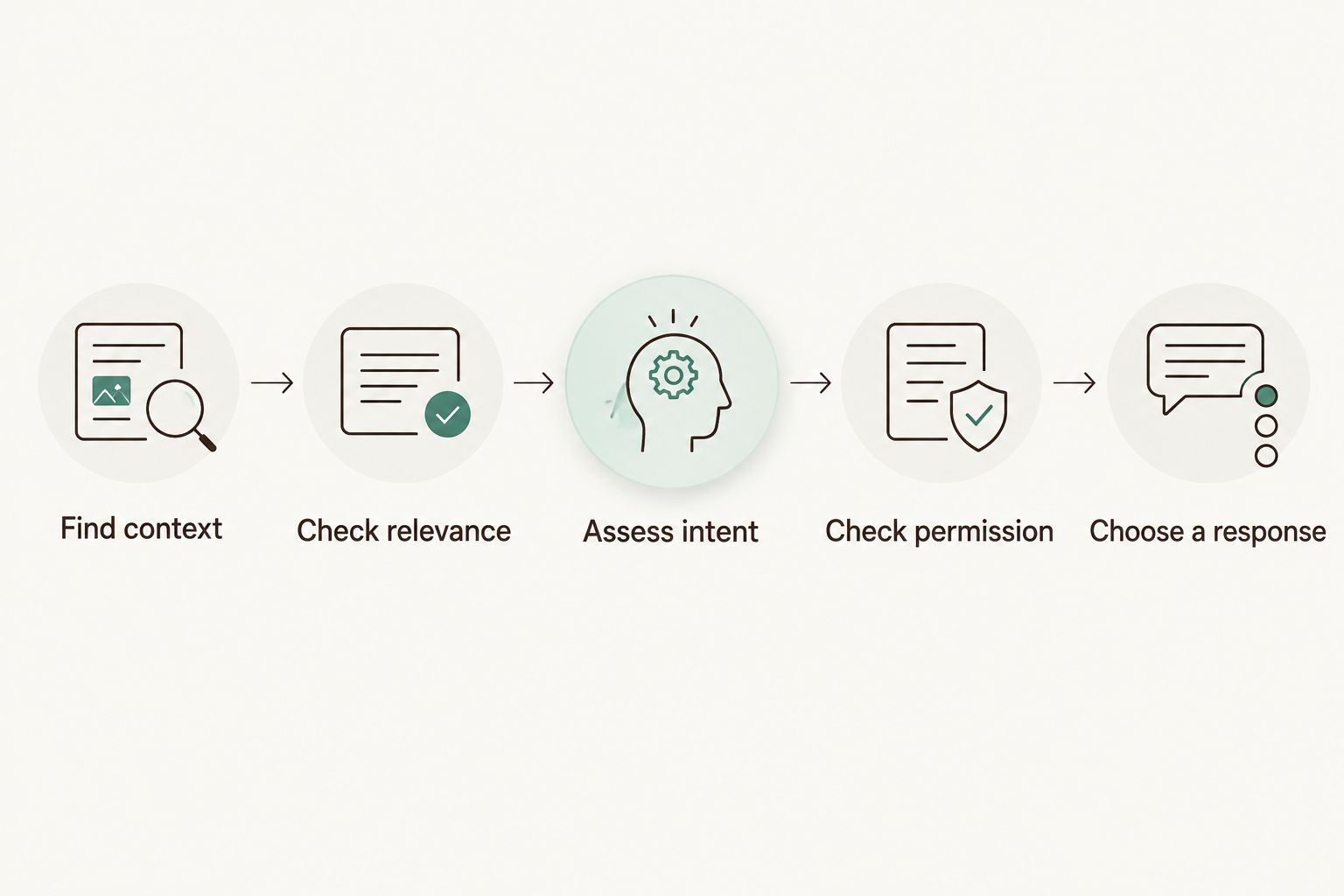
Follow this sequence before adding a person to a sales workflow:
- Find context. Open the original post and surrounding replies. Confirm that the discussion concerns the problem your product addresses.
- Check relevance. Identify the person's stated task, obstacle, or request. Do not substitute assumptions about their job title or company.
- Assess intent. Separate a general complaint from a request for recommendations, an active evaluation, or a switching question.
- Check permission. Read the invitation, community rules, and channel expectations. Permission to answer publicly is not automatically permission to send a private pitch.
- Choose a response. Answer the question, ask whether further detail would help, or leave the conversation alone. Record what happened without upgrading the result beyond its evidence.
A useful review record contains the source, the relevant wording, your interpretation, the permitted next action, and any later response. Preserve enough context to explain your decision without copying unrelated personal information into your sales records.
Compare tools on the review process, not the lead label
Start your 2026 shortlist with DROP, Brand24, and Awario. Use the same customer-discovery scenario for each, and verify current features through official product documentation before deciding. A comparison name is not evidence of equivalent source coverage or workflow support.
The table separates the supplied product description from questions you need to resolve during evaluation. It does not assign unsupported feature advantages to any vendor.
| Tool | Best for in this evaluation | What to examine | Limitation to retain |
|---|---|---|---|
| DROP | SaaS founders assessing conversation-led customer discovery | Whether the conversations you review reveal a relevant problem and a justified next action | Finding a potential customer does not establish permission or conversion |
| Brand24 | A comparison slot for your own discovery requirements | Current official documentation, source access, original-post context, and review workflow | Do not assume a capability or channel is supported without verification |
| Awario | A comparison slot for your own discovery requirements | Current official documentation, source access, original-post context, and review workflow | Do not infer contact permission from a surfaced mention |
The advantage of starting with a shortlist is that you can compare the same job rather than unrelated feature lists. Its limitation is that a shortlist alone says nothing about which tool fits your actual conversations.
For each candidate, write down the official source and the date you checked it. Confirm what a feature includes, not just whether its name appears on a page. A claim about monitoring a network still needs examination of the content types, access conditions, and context available to you.
Choose software that supports your review decision, not software that merely labels more records as leads. A useful result can still be irrelevant to your product, unsuitable for contact, or impossible to interpret without the full thread.
Separate mentions from confirmed customers
Your 2026 evaluation needs consistent definitions. Otherwise, a dashboard count can change meaning as it moves from discovery notes to a sales report.
These are evidence categories, not automatic stages that every person passes through:
| Category | Evidence you have | What it does not prove |
|---|---|---|
| Mention | A post refers to a product, topic, or problem | Relevance to your offer or willingness to engage |
| Relevant conversation | The discussion concerns a problem your product addresses | Purchase intent or permission for private contact |
| Qualified opportunity | Your documented criteria for fit and an appropriate next step are met | A purchase or a guaranteed outcome |
| Confirmed customer | A purchase or customer relationship is confirmed in your business records | Satisfaction, retention, or permission for unrelated marketing |
Define your qualification criteria before reviewing results. For example, require a stated problem that matches your product and an appropriate next action supported by the conversation. These are suggested review criteria, not measured predictors of conversion.
The benefit of this separation is clearer reporting: you can explain exactly what a result represents. The trade-off is manual judgment. Software output does not remove the need to read, interpret, and occasionally reject an apparently promising conversation.
Why permission to contact varies
Permission depends on the actual conversation and channel, not just the fact that a post is public. Use these factors to decide what response, if any, is appropriate:
- The request. An explicit request for product recommendations differs from a personal account of a frustrating experience.
- The channel. A public reply and a private message are different actions. An invitation to one does not automatically cover the other.
- Community rules. Check the rules governing promotion and participation before mentioning your product.
- The surrounding discussion. Replies can clarify that the person wants troubleshooting, peer experience, or no commercial recommendations.
- The person's response. A request for more detail supports that next exchange. Silence is not affirmative agreement to continue pitching.
- Applicable requirements. Check current platform policies and the legal requirements relevant to your activity. A workflow checklist is not legal clearance.
This guide uses consent before contact as a practical outreach standard, not as a claim that every public reply requires the same legal form of consent. Distinguish the communication someone invited from the communication you want to send.
When the invitation is unclear, do not treat ambiguity as permission for a private sales pitch. You can answer a public question where appropriate without enrolling the author in an outreach sequence.
Does a public post give you permission to send a sales message?
No. A public post makes a statement visible; it does not establish permission for every subsequent use or contact method. Read what the author actually requested before deciding whether to respond.
If someone asks for recommendations, a relevant public answer can address that request. Disclose your relationship when mentioning your own product, avoid unrelated claims, and ask before moving into a private product discussion.
The practical benefit is that your response remains connected to the person's stated need. The constraint is that some relevant conversations will not offer an appropriate sales action. Keep those as research rather than forcing them into a pipeline.
What counts as a qualified opportunity from social listening?
A qualified opportunity meets your documented fit criteria and has an appropriate next step supported by the conversation. A complaint, competitor mention, or apparent job title is not enough by itself.
Record the evidence behind the classification. Separate what the author explicitly said from what you inferred, and leave uncertain fields unresolved rather than filling them with assumptions.
If your 2026 report includes qualified opportunities, keep the definition beside the count. Do not rename mentions as leads to make the report look stronger. A reply, a meeting, and a confirmed customer also require their own evidence.
How do you evaluate a tool without sending mass outreach?
Review a defined set of conversations manually and assess whether each result supports a useful decision. You can evaluate discovery quality without contacting every person whose post appears.
Use this practical review record:
- Search purpose: The customer problem or buying question you want to understand.
- Source evidence: The original post and the wording supporting relevance.
- Interpretation: Whether the discussion shows research, dissatisfaction, evaluation, or something else.
- Contact decision: Public response, permission request, research only, or no action.
- Observed outcome: Only what actually happened after your action.
The strength of this method is that you can inspect why a result matters. Its limitation is that it evaluates your review process, not proven revenue impact. If you have not observed purchases, do not report conversion performance.
Before committing to a tool in 2026, also check how much review work the results require. A stream of plausible matches still demands attention. Prefer a manageable, explainable workflow over a volume target that encourages rushed contact decisions.
Try conversation-led customer discovery
Evaluate DROP against your own relevance, evidence, and contact-permission criteria.
FAQ
What's the best way to use social media lead generation tools?
Use social media lead generation tools to find relevant conversations, then review context, intent, and permission separately. Treat each result as evidence to inspect, not as a person automatically ready for sales contact.
Does a public social media post mean I can send a private sales message?
No, a public post does not establish permission for a private sales message. Check the author's request, the surrounding discussion, community rules, and applicable requirements before choosing a response.
Is a competitor mention a qualified lead?
No, a competitor mention alone is not a qualified lead. It can refer to current use, past experience, research, or hearsay; inspect the original wording before classifying it.
Which social listening tools should a SaaS founder compare?
Start with DROP, Brand24, and Awario as an evaluation shortlist, not a verified feature ranking. Check current official documentation and assess each against the same customer-discovery task.
Can I evaluate social listening software without contacting anyone?
Yes, you can evaluate whether surfaced conversations are relevant and understandable without contacting their authors. This assesses discovery and review quality, not customer acquisition or conversion.
What should I record before replying to a potential customer?
Record the source, the relevant statement, your interpretation, and the action the conversation supports. Keep explicit statements separate from assumptions, and avoid collecting unrelated personal information.
Does social listening guarantee customers?
No, social listening does not guarantee customers. A relevant conversation, an accepted response, and a confirmed purchase are distinct outcomes that require separate evidence.
One last thing
A decision not to contact someone can be a correct discovery outcome. You can learn how people describe a problem without turning each author into an outreach target.
Before sending a message, write down the sentence that supports both relevance and your proposed next action. If you can explain only why the person fits your market—not why this contact is appropriate—keep reviewing rather than sending.